A source-material-depth-time method for drying a clean-water spill, checking hidden upholstery, and separating ordinary moisture from contamination.
The right ergonomic setup should adapt to your body, support frequent movement, and stay comfortable through a full workday.
To dry a wet office chair, first identify what the liquid was and how far it penetrated. For a small clean-water spill, stop using the chair, follow its care label, press with clean white towels to remove free water, and move air across the damp material in a low-humidity room. Do not rub, soak the chair again, apply an unapproved cleaner, or use a hair dryer or other concentrated heat. A chair exposed to floodwater, sewage, an unknown chemical, a body fluid, visible mold, or deep saturation needs a different response: isolate it and obtain workplace, manufacturer, restoration, or disposal guidance before running a fan.
A dry-looking surface is not proof that foam, seams, the underside, a mechanism, or an electrical component is dry. The practical goal is to remove moisture from the complete affected layer without damaging the upholstery or spreading contamination—not merely to make the top feel less wet.
Classify the incident before you dry anything
Write down four facts: source, material, depth, and time. This record determines whether ordinary drying is appropriate and gives customer support or a restoration professional something useful to assess.
| Factor | What to record | Why it changes the response |
|---|---|---|
| Source | Clean tap water, cleaning moisture, drink, roof/plumbing leak, floodwater, sewage, body fluid, chemical, or unknown liquid | A clean-water drying method does not establish that a contaminated porous chair is clean or sanitary |
| Material | Open mesh, woven fabric over foam, removable cushion, leather, faux leather, wood composite, metal/plastic, or powered component | Each layer holds water differently and may have a different cleaning code or heat limit |
| Depth | Surface droplets, damp textile, wet seams, saturated foam, wet underside, pooled water, or affected controls | Moisture trapped inside a padded seat may remain after the face fabric appears dry |
| Time | When the incident happened, when drying began, and whether the material stayed wet overnight or longer | Delayed drying raises the need for closer inspection and professional judgment |
The U.S. Environmental Protection Agency's clean-water damage table treats upholstered furniture as a difficult-to-dry material: it recommends water extraction, fans and dehumidification, notes that complete drying within 48 hours can be difficult, and advises consulting a furniture restoration specialist for valuable pieces. The same table says its directions are for clean water—not sewage, floodwater, or chemical or biological contamination.
Use this triage map
| What happened | Immediate action | Drying route |
|---|---|---|
| A small amount of known clean water reached a water-safe surface | Remove the chair from use and blot promptly | Use the controlled air-drying sequence below |
| The chair is damp after an approved cleaning process | Stop adding liquid; remove residue and free moisture as the care instructions specify | Ventilate and dehumidify; keep it out of service until the complete affected area is dry |
| A drink, cleaner, oil, ink, or other known substance was spilled | Blot without spreading it and check the material instructions | Treating the residue or stain may be required before final drying; do not invent a cleaner from the word “fabric” alone |
| Foam is saturated, water reached inaccessible cavities, or the chair remained wet for an extended period | Keep the chair out of use and document the affected layers | Ask the manufacturer or an upholstery/water-damage professional whether the chair can be fully dried and retained |
| Floodwater, sewage, a body fluid, a chemical, visible mold, or an unknown source is involved | Isolate the chair; do not press, vacuum, or blow air through it as an ordinary DIY task | Follow workplace exposure procedures, local disposal rules, and qualified remediation advice |
| A powered control, heater, massage unit, battery, cable, plug, or outlet became wet | Do not energize or operate it; disconnect only if that can be done safely | Use the product's electrical incident instructions or qualified service assessment—not an upholstery-only test |
Do not point a fan at material of uncertain sanitary status. EPA's clean-water table specifically says to determine that the water is clean or sanitary before using fans, because airflow can spread contaminants. CDC disaster guidance likewise warns that floodwater may contain sewage, agricultural waste, and industrial waste and recommends discarding upholstered or foam items that cannot be cleaned and dried quickly. See the CDC disaster cleanup guidance when the event is more than an ordinary indoor spill.
How to dry a chair after a small clean-water spill
The sequence below is for a prompt response to a limited, known clean-water spill when the product instructions allow moisture on the affected material. It is not a disinfection, mold-remediation, or flood-recovery procedure.
- Take the chair out of service. Move it only if the path is clear and the chair remains stable. Do not sit on it to “squeeze out” water. Keep it away from a powered desk outlet, power strip, and floor cable.
- Find the exact material instructions. Check the product manual, care label, upholstery cleaning code, and any model-specific support page. A zipper does not prove a cover is removable or washable. An X- or S-coded textile should not be treated like a W-coded textile.
- Record the wet area. Photograph the top, seams, underside, and nearby controls. Mark the approximate boundary with removable paper placed beside—not on—the material. This makes it easier to detect spreading and report the incident later.
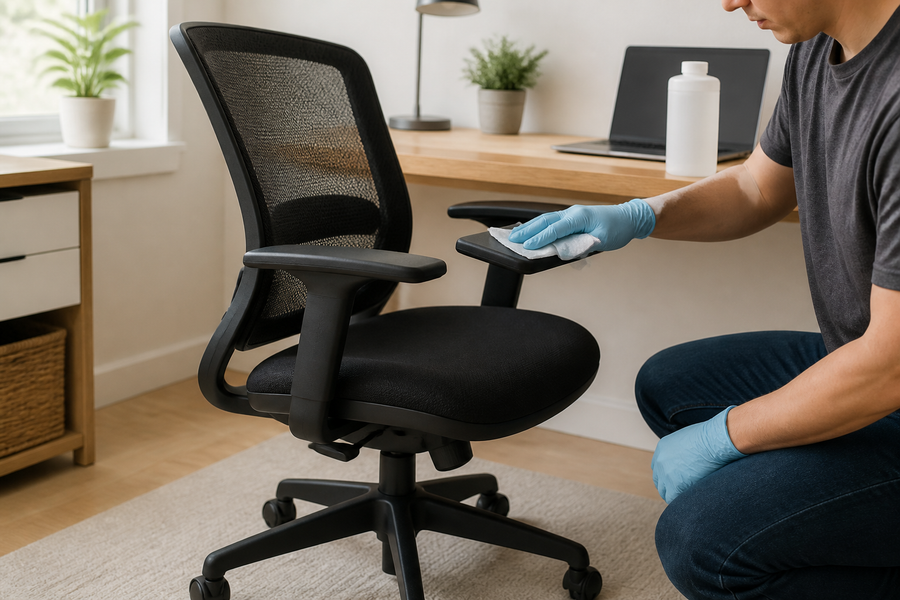
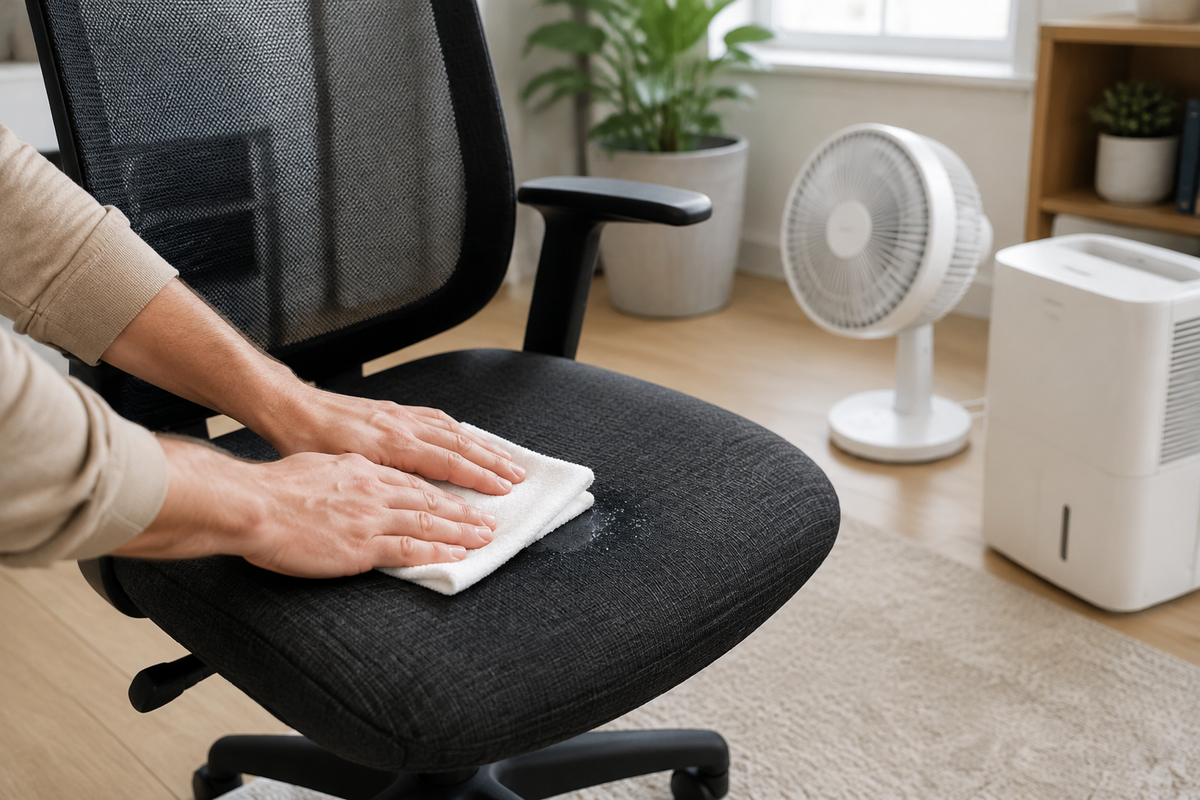
- Remove free water by pressing. Place a clean, colorfast white towel on the wet area and press vertically. Lift it, rotate to a dry section, and repeat. Do not scrub, twist foam, or push water toward seams and adjustment openings.
- Extract only when the instructions permit it. For a larger clean-water event, a water-extraction upholstery tool may remove moisture that towels cannot reach, which is consistent with EPA's general upholstery guidance. But suction can stretch mesh, disturb coatings, or pull on seams. Use it only when the chair manufacturer or a qualified upholstery professional approves the method for that construction.
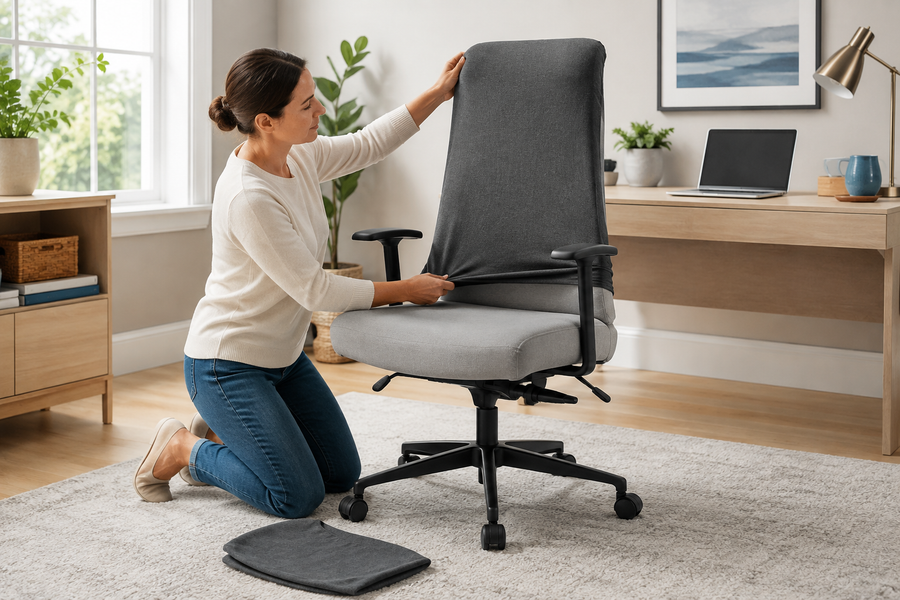
- Expose accessible surfaces without improvising disassembly. Remove a cushion or cover only if the current instructions identify it as user-removable. Do not open a tilt housing, detach load-bearing parts, pry off upholstery, puncture foam, or remove a powered module just to create airflow.
- Create cross-flow. Put the stable, unloaded chair in a clean, low-humidity room. Aim a fan so air moves across the damp area, and use a dehumidifier according to its own clearance and electrical instructions. Keep cords and appliances away from the wet chair.
- Recheck hidden collection points. Press a fresh towel at seams and the accessible underside. Look beneath the seat, around fasteners, and near adjustment paddles for droplets or continued water transfer. If moisture keeps returning to the surface, the inner layer remains wet.
- Keep the chair unused through verification. Continue controlled airflow until the face, seams, underside, and all accessible layers show no moisture. If you cannot assess the inner foam or the material stays damp, stop the DIY process and ask for a professional or manufacturer decision.
For routine cleaning rather than an accidental soaking, use OdinLake's chair-cushion cleaning guide to match the method to mesh, fabric, foam, leather, or faux leather. The older OdinLake mesh-chair care guide also tells owners of the named model to air-dry completely and avoid heat and direct sunlight. Those pages own routine cleaning; this guide owns water removal and post-incident drying.
Why a hair dryer or concentrated heat is a poor default
Heat is not interchangeable with drying. A hair dryer can create a small high-temperature zone while the foam beneath remains wet. Depending on the chair, concentrated heat can affect textile color, coatings, adhesives, plastic, foam, mesh tension, or nearby electronics. Direct sunlight can also heat and fade one area unevenly.
EPA's building guidance says air circulation and temperature can increase drying speed, and its clean-water table lists heaters among professional tools. That does not make a consumer hair dryer safe for every office chair. A restoration setup controls heat, distance, airflow, humidity, and material response. At home, use room-scale ventilation and dehumidification unless the exact manufacturer instruction authorizes another method.
The 24–48 hour window is not a chair drying time
EPA says wet furnishings should be dried quickly, generally within 24–48 hours, to reduce the opportunity for mold growth. CDC/NIOSH similarly recommends drying wetted materials within 48 hours or removing them. These are moisture-control and remediation decision windows; they do not promise that every chair will be dry in two days.
Drying time varies with the volume of water, upholstery permeability, foam thickness, seam design, room humidity, air speed, temperature, and whether moisture entered a closed cavity. A mesh back with surface droplets and a thick padded seat with saturated foam are different jobs. “Wait 24 hours” is therefore not a valid universal instruction.
The CDC/NIOSH mold guidance also says thorough visual inspection and detection of musty odors are more reliable than short-term air sampling for locating dampness and mold problems in buildings. For a chair, a consumer mold kit or a brief negative air sample should not be used as proof that hidden upholstery is dry or suitable for return to service.
Check every layer before returning the chair to use
Use a repeatable closeout check rather than a single touch of the seat top:
- Press a fresh white towel on the face, seams, edges, and accessible underside; there should be no water transfer.
- Compare the affected area with a known-dry area for temperature, color, and feel. A cool spot can suggest evaporation, but equal temperature does not prove hidden foam is dry.
- Inspect for tide marks, swelling, delamination, loosened adhesive, puckered fabric, stretched mesh, rust, corrosion, or water trapped behind a transparent part.
- Check for visible growth and a new musty odor. Their absence is necessary but is not a sanitation certificate.
- Verify that accessible controls and connections are dry and visually intact. Do not operate a formerly wet powered feature until the applicable instructions or service provider approve it.
- Confirm the original water source is stopped. Drying a chair beneath an active roof or plumbing leak does not complete the incident.
A towel press can reveal remaining moisture, but a clean towel cannot measure the center of a thick foam cushion. Consumer surface moisture meters are also material-specific and may give misleading readings on mixed textile, foam, wood, plastic, and metal assemblies. If internal dryness matters and the core is inaccessible, use professional assessment rather than a guessed threshold.
Stop drying and escalate when the evidence changes
Keep the chair out of service and contact the appropriate owner when any of these conditions applies:
- the source is floodwater, sewage, a chemical, a body fluid, or is unknown;
- water reached a plug, cable, battery, heated surface, massage unit, motor, control box, or other electrical component;
- foam remains damp, moisture reappears, or the complete wet area cannot be accessed;
- the incident was discovered late, the chair stayed wet for more than 48 hours, or the timeline is unknown;
- visible mold, a musty odor, discoloration, corrosion, swelling, delamination, or material breakdown appears;
- the chair was submerged or saturated by a building leak or flood;
- the care code is missing, contradictory, or prohibits water-based treatment; or
- the model instructions do not authorize removal of the parts needed to reach the wet layer.
For an OdinLake model, record the product label, order details, source of water, elapsed time, and clear photographs before contacting support. Review the current OdinLake warranty policy; coverage depends on the model, component, purchase source, terms, maintenance, and support diagnosis. Drying advice does not determine warranty coverage.
Frequently asked questions
Can a wet office chair be dried?
A limited clean-water spill may be dryable when the upholstery instructions allow water and the moisture can be removed from every affected layer. Saturated foam, inaccessible cavities, contaminated water, visible mold, odor, or wet electrical parts require manufacturer, workplace, restoration, or disposal guidance.
How long does an office chair take to dry?
There is no universal time. Mesh with surface moisture may dry much faster than thick foam, while high humidity and poor airflow slow both. The 24–48 hour guidance from EPA and CDC is a prompt-drying/remediation window, not a guaranteed chair drying duration.
Can I use a hair dryer on a wet office chair?
Do not use one as a generic method. Concentrated heat can affect fabric, foam, coatings, adhesives, plastic, mesh tension, or electronics while leaving deeper material wet. Prefer room-scale airflow and dehumidification unless the exact chair instructions authorize a heat method.
Can I leave a wet office chair in the sun?
Direct sun is not a safe default because heat and ultraviolet exposure can fade or alter some upholstery and plastics. Use a clean, ventilated, low-humidity indoor space unless the model's care instructions explicitly permit outdoor or sun drying.
How do I know whether the foam inside is dry?
Check the seams, edges, accessible underside, and face with a fresh white towel and look for recurring moisture. No transfer is useful evidence, but it does not prove the center of inaccessible foam is dry. Persistent coolness, dampness, odor, or returning moisture is a reason to keep the chair out of use and seek assessment.
What should I do if floodwater or sewage soaked the chair?
Do not apply the small-spill method or start a fan. Isolate the chair and follow public-health, workplace, restoration, and local disposal guidance. CDC says floodwater can contain sewage and other waste and lists upholstered furniture and foam items among materials to discard when they cannot be cleaned and dried quickly.