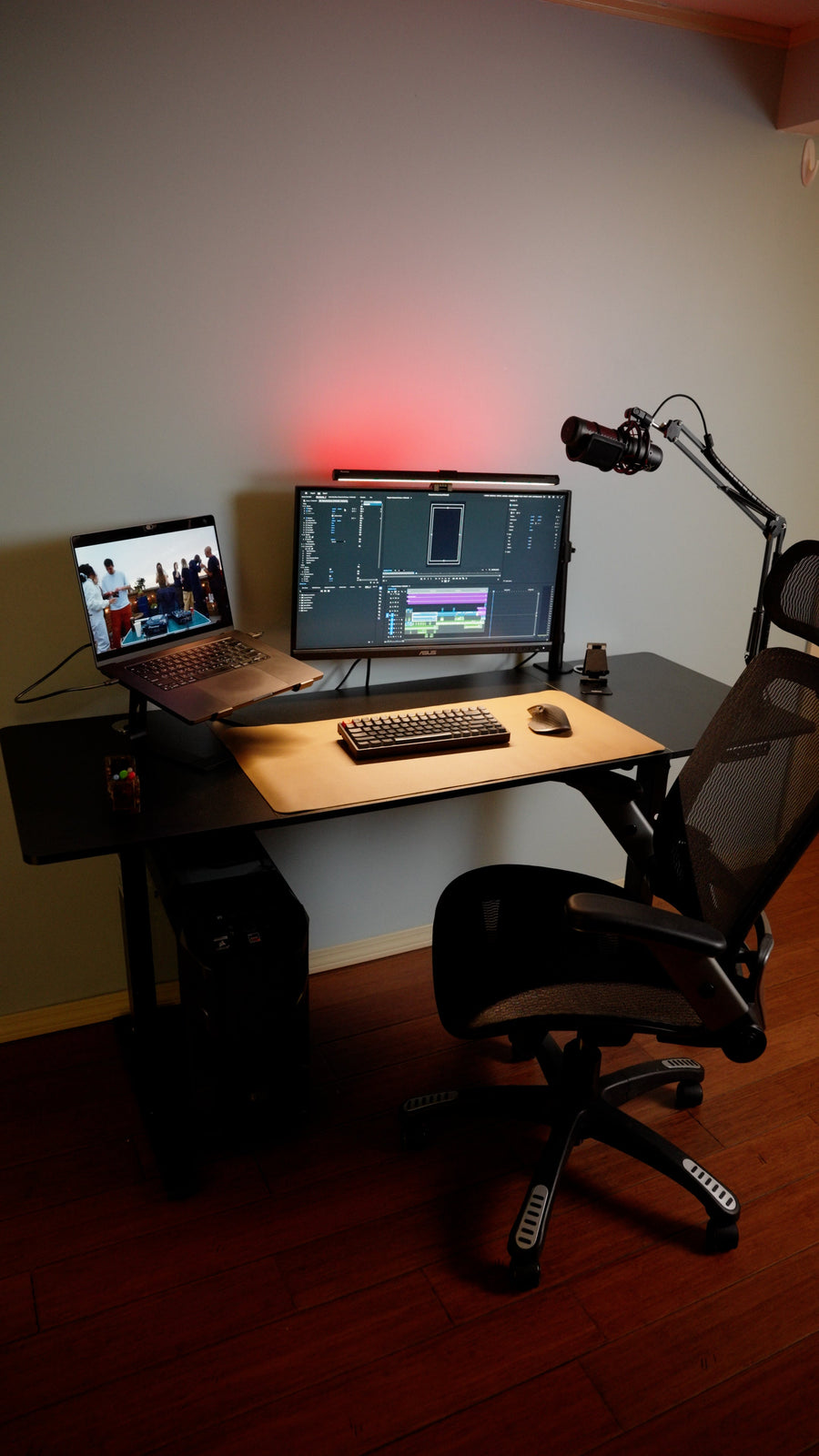
The right ergonomic setup should adapt to your body, support frequent movement, and stay comfortable through a full workday.
No single person can be credibly named as the inventor of the standing desk. The answer changes according to what “standing desk” means: a fixed writing surface used while standing, an adjustable reading stand, a desk that moves between sitting and standing heights, or today’s electric height-adjustable workstation. Those are related objects, but they did not appear at the same time or come from one inventor.
The strongest surviving evidence points to a long sequence of development. European furniture makers built adjustable reading-and-writing tables in the 1700s. A U.S. patent from 1876 explicitly described a writing surface for use “either sitting or standing.” A 1909 patent then documented a convertible office desk with a mechanically raised top. Modern electric desks added motors, controllers, sensors, and standardized frames much later.
Source-checked answer: the standing desk is a product category with many contributors, not a one-person invention. Martin Carlin, David Roentgen, Charles A. Atkinson, and James G. S. Dey are associated with documented milestones, but none can be shown to have invented every form that the term covers.
First, Define the Object
A history becomes misleading when it treats every elevated writing surface as the same invention. Four categories make the evidence easier to read:
| Object type | What changes | What it can establish | What it cannot establish by itself |
|---|---|---|---|
| Fixed standing writing surface | Nothing; the surface is simply high | People could read or write while standing | The invention of height adjustment |
| Adjustable lectern or reading table | A smaller tray changes height or angle | Furniture supported seated and standing use | A full-size modern office desk |
| Convertible sit-stand desk | A usable worktop moves between positions | One workstation was designed for both postures | Electric operation or modern controls |
| Modern electric standing desk | Powered columns move the desktop | A contemporary height-adjustable system | Who first used any desk while standing |
This distinction also explains why a patent cannot settle the whole question. A patent describes particular claims for a particular mechanism. It may be excellent evidence for that mechanism and still say nothing about earlier fixed tables, other countries, or unpatented workshop traditions.
A Documentary Timeline of Sit-Stand Furniture
The dates below are not a claim that nothing similar existed earlier. They are checkpoints supported by museum objects, invoices, or patent records that can be inspected today.
About 1760–1765: an adjustable French reading-and-writing table
The Metropolitan Museum of Art catalogs an adjustable reading and writing table dated to about 1760–1765 and attributed to French cabinetmaker Martin Carlin. Its tilting lectern slides over a notched steel rod. A brass ratchet lets the tray change height for use from a seated or standing position.
This is strong physical evidence that adjustable furniture for both postures existed in the mid-18th century. The attribution must remain narrow, however. The object is unsigned, the Met says it is attributed to Carlin, and the form had variants. It does not prove that Carlin originated the entire idea of standing work.
1786: multiple Roentgen tables documented in one shipment
A second Met record describes a mechanical architect’s table by David Roentgen, dated approximately 1780–1795. More than 40 versions of the type are known. Most importantly, an invoice records that Catherine the Great received at least nine such tables in 1786 for writing while sitting and standing.
That invoice changes the scale of the story. It shows a recognized furniture type made in multiples for a major client, not merely an improvised high table. The museum also describes the surviving piece as a late stage in the model’s evolution. That language argues against treating it as a single moment of invention.
The 1860s: adjustable school furniture enters a broader market
The Smithsonian’s Joseph L. Ross Primary School Desk provides a different branch of the history. Its collection record explains that Ross desks in the 1860s could be ordered with adjustable-length legs and were later marketed for use while standing or sitting.
A school desk is not an office desk, but the record matters because it shows that adjustable-height furniture was moving beyond elite mechanical tables. Adaptability could now be specified for repeated manufacture and for users of different sizes.
1876: a U.S. patent states “sitting or standing” directly
Charles A. Atkinson’s U.S. Patent 174,404, granted March 7, 1876, is one of the clearest American records in this timeline. The writing surface was a door that swung down from the upper part of a desk. It could shift vertically to suit different people, be used while sitting or standing, and change from flat to inclined.
The patent is valuable because the intended postures and adjustments are explicit rather than inferred from a picture. It is still safest to call it an early documented U.S. sit-stand desk patent, not “the first standing desk patent.” Earlier patents may use different terminology, records outside the United States may predate it, and centuries-old furniture was not always patented.
1909: a convertible flat-top office desk
James G. S. Dey’s U.S. Patent 928,185, granted July 13, 1909, looks closer to the office category. It describes a flat-top desk with a second worktop raised by racks, pinions, a shaft, and a hand wheel. The top could remain low for seated work, rise for standing work, or stop at intermediate heights for different people.
Dey did not claim every elevated desk ever made. He claimed defined improvements to a convertible office desk. The mechanism is therefore a useful milestone between earlier adjustable furniture and later height-adjustable workstation systems.
The Leonardo Claim Is Famous, but Not Documented
Leonardo da Vinci is frequently named in short online histories, sometimes with a date in the 1400s. Yet a repeated statement is not the same as an identified drawing, surviving object, workshop record, or contemporary description.
In the museum and patent sources reviewed for this article, we found no primary or curatorial record that identifies a particular Leonardo object as the invention of the standing desk. That does not prove he never drew, read, or worked at a tall surface. It means the stronger claim—“Leonardo invented the standing desk”—does not have enough traceable evidence here to present as fact.
A reliable attribution should name the document or object, its date, what feature it shows, and how the institution interprets it. Without those pieces, Leonardo belongs in the “popular but unverified claim” column, not at the start of a factual invention timeline.
Jefferson Was an Adapter, Not the Category’s Inventor
Thomas Jefferson is also attached to the invention story because his Monticello study contained specialized writing furniture. He did use a carefully organized workstation, and he helped tailor objects to his own correspondence workflow. That establishes an important history of use and adaptation.
It does not establish sole invention. Monticello’s curatorial account of Jefferson’s correspondence system says that he did not invent the furniture forms in his writing workstation; he adapted innovative designs for convenience and efficiency. His role should therefore be described with verbs such as used, specified, adapted, or designed for his needs when a source supports them—not expanded into a blanket claim that he invented the standing desk.
Why No Patent Can Name the One True Inventor
Patent dates are precise, which makes them tempting answers to a messy history question. But three limits remain:
- Terminology changes. Older records may say reading stand, architect’s table, school desk, writing desk, or convertible office desk rather than standing desk.
- Patents cover claims, not categories. Atkinson’s adjustable door and Dey’s raised secondary top are different mechanisms aimed at a related result.
- Furniture predates the patent system used here. Surviving 18th-century objects already document seated and standing use before either U.S. patent.
The most accurate historical method is to connect each person to a documented contribution. Carlin is the attributed maker of one surviving adjustable table. Roentgen produced a well-documented type in multiples. Atkinson patented an adjustable writing surface explicitly intended for sitting or standing. Dey patented a convertible office desk with a mechanically raised top. None of those statements requires inventing a single winner.
How the Historical Idea Became a Modern System
The basic aim stayed recognizable: move a work surface to suit the task, posture, or user. The engineering changed substantially. Ratchets, notched rods, extensible braces, racks, pinions, and hand wheels gave way to spring-assisted bases, hand cranks, pneumatic systems, and powered lifting columns.
A modern electric desk is best understood as a system rather than a tall table. The frame must lift and stabilize the load, a controller must coordinate motion, and safety and control behavior depend on the model. Our explanation of how a sit-stand desk works covers those present-day mechanisms. For category terminology and everyday use, see the complete guide to standing desks.
Those modern guides answer different questions from this history. A decorative 18th-century lectern should not be treated as a specification ancestor of a current product, and an old patent does not demonstrate modern stability, load capacity, control features, or suitability for a particular workspace.
The Most Defensible One-Sentence Answer
If you need a concise answer, use this: No one person invented the standing desk; adjustable sit-and-stand furniture is documented in the 1700s, while Atkinson’s 1876 patent and Dey’s 1909 patent record important U.S. developments toward the convertible office desk.
That sentence is less catchy than naming Leonardo or Jefferson, but it keeps the object types, dates, and evidence aligned. It also leaves room for future archival discoveries instead of presenting an uncertain “first” as settled history.
Research Method and Limits
This account prioritizes institutional collection records, dated invoices discussed by museum curators, and patent documents that describe how a mechanism worked. Dates are attached to the evidence that supports them: an object range, an invoice, an application, or a patent grant.
The timeline is not an exhaustive catalog of every high writing surface ever made. Furniture can disappear, change ownership, be altered, or survive without documentation. Patent searches are also sensitive to historical vocabulary and national boundaries. For those reasons, the article identifies documented milestones and avoids declaring an absolute world first.
Frequently Asked Questions
When was the standing desk invented?
There is no reliable single invention date. Adjustable furniture designed for seated or standing use survives from about 1760–1765, an invoice documents multiple sit-and-stand writing tables in 1786, and explicit U.S. desk patents followed in 1876 and 1909.
Did Leonardo da Vinci invent the standing desk?
No source reviewed here establishes that claim with an identified object, drawing, or contemporary record. Leonardo may have used many kinds of work surfaces, but that is different from proving that he invented the standing desk.
Did Thomas Jefferson invent the standing desk?
No. Jefferson used and adapted specialized writing furniture, but Monticello’s curators state that he did not invent the furniture forms in his workstation. He is an important historical user and adapter, not a proven sole inventor of the category.
Who patented an early sit-stand desk?
Charles A. Atkinson received U.S. Patent 174,404 in 1876 for a writing surface that moved vertically and could be used sitting or standing. It is an early explicit U.S. patent milestone, not proof of the first such desk anywhere.
What is the difference between a standing desk and a sit-stand desk?
A standing desk may be any desk fixed or set at standing height. A sit-stand desk has an adjustment range intended to place the work surface at both seated and standing heights. The terms are often used interchangeably in modern shopping, so the mechanism and height range matter more than the label.
Are electric standing desks a recent invention?
Electric lifting systems are recent compared with the centuries-old idea of adjustable writing furniture. Earlier examples used ratchets, braces, screws, racks, pinions, or hand wheels. A modern powered desk adds motors, electronic controls, and other model-specific components.