A laminate-specific method for choosing compatible casters or a hard-floor mat, covering the real rolling path, and checking the setup without guesswork.
The right ergonomic setup should adapt to your body, support frequent movement, and stay comfortable through a full workday.
A rolling office chair can scratch, scuff, or otherwise change laminate flooring, but the result depends on the exact floor, caster, debris, rolling pattern, and protection layer. The reliable approach is to identify the laminate product, follow its current care and warranty instructions, clean and inspect all five casters, then use a compatible hard-floor mat, approved soft-tread casters, or both. Finish with an occupied roll test that keeps every wheel on one supported surface.
Do not treat “scratch resistant,” “floor safe,” or “universal” as a guarantee. Laminate products have different use classifications and care rules, while a wheel that is gentle when clean can still carry abrasive grit. This guide gives you a reproducible protection setup without assuming that one mat or caster is right for every floor.
Start With the Laminate Product, Not the Chair Accessory
Before buying a mat or replacement wheels, identify the floor as precisely as you can. Check the installation invoice, leftover carton or plank, product label, landlord record, builder documents, or installer. Record the manufacturer, collection, product code, installation type, installation date, and any current warranty.
Then search the manufacturer’s current documents for terms such as rolling chair, caster, chair mat, rolling load, floor protector, rug backing, and abrasive dirt. The floor maker—not the appearance of a wood-look plank—controls what may contact that specific surface.
Current instructions do not all use the same protection language. For example, Shaw’s laminate-care guidance emphasizes removing dirt and grit that can scratch or dull the finish and using suitable floor protectors or wide load-bearing rollers. Pergo’s current floor-care guidance tells owners to replace plastic chair casters with rubber wheels. These are examples of manufacturer-specific directions, not permission to apply either rule to every laminate floor.
If you cannot identify the floor, ask the installer, landlord, builder, or flooring retailer for written guidance. Until the surface is identified, avoid adhesive protection, carpet mats with teeth, unverified rug backings, aggressive cleaners, and direct rolling that is already leaving a mark.
Use the Existing Condition to Choose Your First Action
Move the chair off the rolling area without dragging it. View the floor in ordinary light and again with light coming from a low angle. Photograph the clean area before changing anything. The observation is a baseline, not a diagnosis: several causes can create similar marks.
| What you observe | What to check next | Immediate action |
|---|---|---|
| Loose grit, hair, or particles on the floor or wheel tread | Whether every caster rolls and swivels freely after approved cleaning | Keep the occupied chair off the floor until both surfaces are clean and dry |
| Faint arcs, scuffs, or a dull patch in the repeated rolling zone | Dragging wheels, embedded debris, exposed mat edges, and the floor maker’s cleaning instructions | Stop direct rolling; photograph the area and use only the approved cleaning method |
| One caster clicks, scrapes, wobbles, or has a rough or flat tread | Caster damage, trapped fibers, loose retention, and model-compatible replacement options | Do not use the occupied chair on the laminate until the chair maker’s remedy is completed |
| A plank joint looks raised, separated, chipped, or newly uneven | Floor installation, subfloor support, rolling-load instructions, and any moisture exposure | Stop rolling across that area and contact the flooring installer or manufacturer |
| The mat shifts, curls, clouds, or leaves residue underneath | Hard-floor approval, backing compatibility, flatness, load rating, and trapped moisture or grit | Remove it according to its instructions without dragging debris across the floor |
| The floor is clean and intact | Product-specific caster and mat rules plus the chair’s complete travel area | Install and test a documented protection route before long-term use |
Do not sand, polish, wax, fill, or solvent-treat a mark unless the exact floor manufacturer provides that repair path. A surface scuff, a worn decorative layer, a chipped edge, and a moving joint are different conditions. An aggressive cosmetic fix can obscure evidence or create a larger problem.
Choose a Protection Route With Two Separate Approvals
Floor compatibility and chair compatibility are separate decisions. The flooring maker controls what may contact the laminate; the chair maker controls which caster or glide can be safely installed. A product must pass both checks before it becomes part of the setup.
| Protection route | Use it when | Verify before installation | Reject it when |
|---|---|---|---|
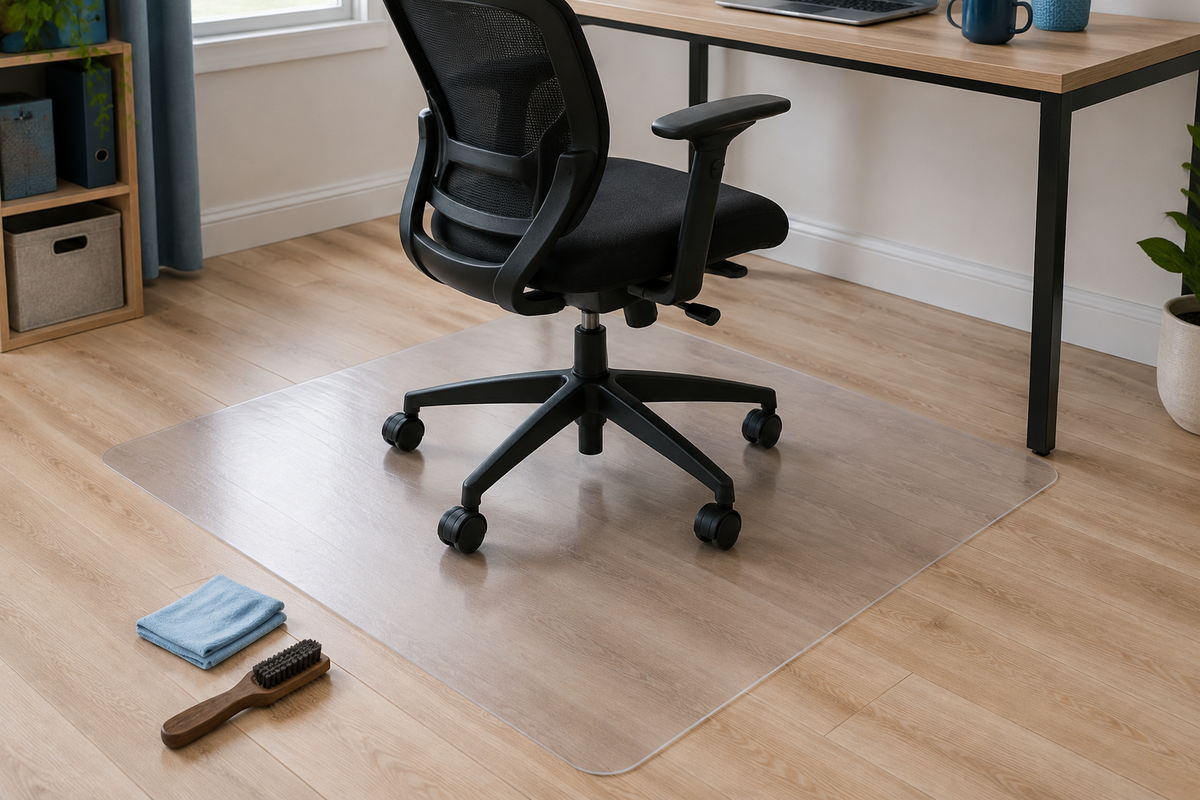
| Hard-floor chair mat | The laminate instructions require or allow one, or you want a defined physical barrier | Laminate approval, smooth non-cleated underside, backing material, occupied-load rating, flatness, edge design, and full rolling-zone size | It has carpet spikes, unverified adhesive, incompatible backing, curled edges, or insufficient coverage |
| Soft-tread caster set | The floor maker allows direct rolling with that tread type and the chair maker approves the complete replacement | Exact chair model, attachment and stem, set rating, mounted height, swivel clearance, floor use, and rolling resistance | The listing relies only on “universal” or “safe for all floors,” or changes chair stability and control |
| Compatible mat plus approved casters | The floor has higher protection priority, use is frequent, or uncertainty remains after one measure | Both approvals, caster-to-mat match, mat size, edge crossing, and predictable occupied rolling | Either component is undocumented or the combination causes binding, sliding, or excessive free rolling |
| Manufacturer-approved stationary glides | The task does not require rolling and the chair maker allows the conversion | Five-point support, attachment, floor-contact material, chair height, and a safe way to reposition the empty chair | The chair rocks, a glide can detach, or users must drag the occupied chair |
The Canadian Centre for Occupational Health and Safety gives a useful general rule: hard plastic casters suit carpet, while soft rubber casters suit hard surfaces such as laminate. It also says a chair mat should be large enough to keep all five wheels on the surface. Apply that guidance together with the exact floor and chair instructions; it does not make every soft wheel or mat compatible.
Build a Closed Rolling Zone
The protected area is not the width of the chair base while it sits neatly at the keyboard. It is the outer path of every caster while you enter, work, reach, roll back, stand, and exit. A mat can protect the center yet fail at the edge where one loaded wheel repeatedly crosses onto exposed laminate.
- Clear the work area. Move the chair and loose objects without dragging them. The expected result is an unobstructed floor area with no cord, mat edge, or furniture leg in the chair path. If moving the chair requires tipping or removing parts, follow the chair’s instructions.
- Clean the floor by its approved method. Remove loose dirt and grit with the hard-surface attachment or method named by the floor maker. The surface should be clean and dry with no cleaner residue. If the correct product is unknown, stop at dry dust removal and ask the floor maker rather than improvising.
- Inspect all five casters. With the chair unloaded and handled as its manual allows, check each tread, axle area, housing, stem, and base socket. Every wheel should rotate and swivel without scraping, flat spots, looseness, or embedded debris. A damaged or binding caster must be resolved before the chair returns to the laminate.
- Map the occupied travel. Put the chair on a temporary safe surface or the selected mat, sit normally, and place loose paper markers just outside the farthest caster position during real tasks. Include side storage and the usual entry and exit direction. Do not tape the markers to laminate unless the floor maker approves the adhesive.
- Size the protection to the outer markers. The usable flat portion—not a lip, curl, or transition—must extend beyond every marker. Keep the mat edge out of doorways and walking paths. If the room cannot fit that area, shorten the chair’s route by moving storage or changing the desk layout; do not accept repeated edge crossing.
- Install on a clean, dry surface. Follow the mat maker’s orientation and acclimation directions. The mat should lie flat with the correct side down and no grit, moisture, tape, or cable underneath. If it rocks, slides, or curls, stop and resolve the product or floor mismatch before sitting.
- Run an occupied roll test. Start at the keyboard, reach to each normal side, roll back, stand, exit, and return. All five casters should remain on the same supported surface, and the chair should move without scraping, binding, catching, unexpected acceleration, or rocking.
- Inspect immediately after the test. Check the wheel treads, mat edges, exposed floor, and—with the mat instructions followed—the underside. A passing result has no new mark, trapped debris, mat movement, edge lift, or change at a plank joint. Correct one failed condition before repeating the test.
A clean empty-chair roll is not enough. Sitting changes how load is distributed, and reaching changes which caster approaches the edge. The test must reproduce the real work path while keeping movement slow and controlled.
Understand What Caster-Chair Testing Can and Cannot Prove
Laminate flooring is not automatically defenseless against caster use. The North American Laminate Flooring Association lists castor-chair durability among the properties evaluated for LF-01-certified products. The published ANSI/NALFA LF-01 test method evaluates changes in appearance and floor stability, including joints, under a caster-chair apparatus.
The method is controlled: the casters are cleaned and inspected, debris is removed during the procedure, and the specimen is examined after 25,000 or 35,000 revolutions, depending on the required level. Reportable observations include conditions such as delamination, seam opening, or crazing; the standard treats gloss or sheen change differently from those forms of damage.
That evidence is useful for reading a product certification, but it is not a promise that any installed laminate will tolerate any office chair without protection. Your floor may use a different product or installation, and real rooms add grit, damaged wheels, repeated edge crossings, moisture, uneven support, and an occupied chair. Check whether the exact product is certified, which use level applies, and what its warranty still requires.
Keep Protection Working After Installation
Recheck the setup after the first normal work session, then make the inspection part of the floor’s existing care routine. Do not invent a calendar interval that conflicts with the floor or accessory instructions. Conditions—not a universal weekly or monthly rule—tell you when the setup needs attention.
- Remove visible grit using the floor maker’s approved method before it travels under a caster or mat.
- Check that every caster still rolls and swivels freely and that no tread is chipped, flat, rough, or loaded with debris.
- Confirm the mat remains flat, clean, dry, and in its original position.
- Inspect the area where casters approach the mat edge and where your feet push during entry and exit.
- Use low-angle light to compare the floor with the baseline photos.
- Re-run the occupied path after moving the desk, adding side storage, changing casters, or replacing the mat.
Stop direct use if a new scratch, dull arc, chip, raised joint, opening seam, mat residue, or sudden change in rolling appears. Photograph the condition and ask the flooring manufacturer or installer how to clean, assess, or repair that exact product. Do not keep rolling to see whether the change gets worse.
Keep Caster Replacement With the Correct Owner
If the protection plan requires different wheels, verify the chair before removing anything. Attachment type, stem dimensions, retention method, installed height, base clearance, complete-set rating, and floor use all matter. “Rollerblade style” describes a shape; it does not establish that the caster fits your chair or is approved for your laminate.
OdinLake’s office-chair wheel replacement guide covers the general inspection and replacement sequence. Follow a model-specific manual or support instruction whenever it differs. Do not drill a base socket, sand a stem, improvise a sleeve, mix caster heights, or force a part that does not seat normally.
If the chair is an OdinLake model and the current records do not resolve caster fit or intended floor use, send the model label, original caster photos, floor product, and proposed protection method to OdinLake support. If the surface turns out to be real wood rather than laminate, use the separate hardwood-floor protection guide; the finish and backing questions are different.
Frequently Asked Questions
Will a rolling office chair damage laminate flooring?
It can, especially when casters drag, carry grit, repeatedly cross a protection edge, or conflict with the floor’s care instructions. Some laminate products are tested for caster-chair resistance, but that does not make every real installation scratch-proof. Use the exact floor documentation, compatible casters, and a complete protected rolling zone.
Do I need a chair mat on laminate flooring?
Use one when the exact laminate care or warranty instructions require it, when direct rolling is already changing the floor, or when a compatible mat is the clearest way to control uncertainty. Choose a hard-floor mat with an approved smooth backing and enough usable area to keep all five casters supported. A generic clear mat is not automatically compatible.
What kind of chair mat is suitable for laminate floors?
Choose a mat whose maker identifies your laminate or hard-floor application and whose backing the flooring manufacturer permits. Verify the occupied-load rating, flatness, edge design, cleaning method, and full rolling-zone size. Do not place a studded carpet mat or unapproved adhesive against laminate.
Are rollerblade-style casters safe for laminate flooring?
The shape alone does not answer the question. Verify the tread material and floor approval, then confirm attachment, stem, installed height, clearance, rating, and complete-set compatibility with the chair. Even an approved soft-tread wheel needs clean treads and a monitored occupied test.
Can grit scratch laminate through a chair mat?
Grit can still become a problem when it is trapped under the mat, embedded in a caster, or carried across an exposed edge. Start with a clean, dry floor and mat underside, then inspect according to both manufacturers’ instructions. Never drag the mat across particles during removal.
What should I do if the laminate is already scratched or the seams are lifting?
Stop chair traffic, photograph the area, and identify the exact flooring product. Use only its approved cleaning or repair instructions. A lifted, opening, chipped, swollen, or otherwise changing joint should be assessed by the flooring manufacturer, installer, or a qualified flooring professional before rolling resumes.