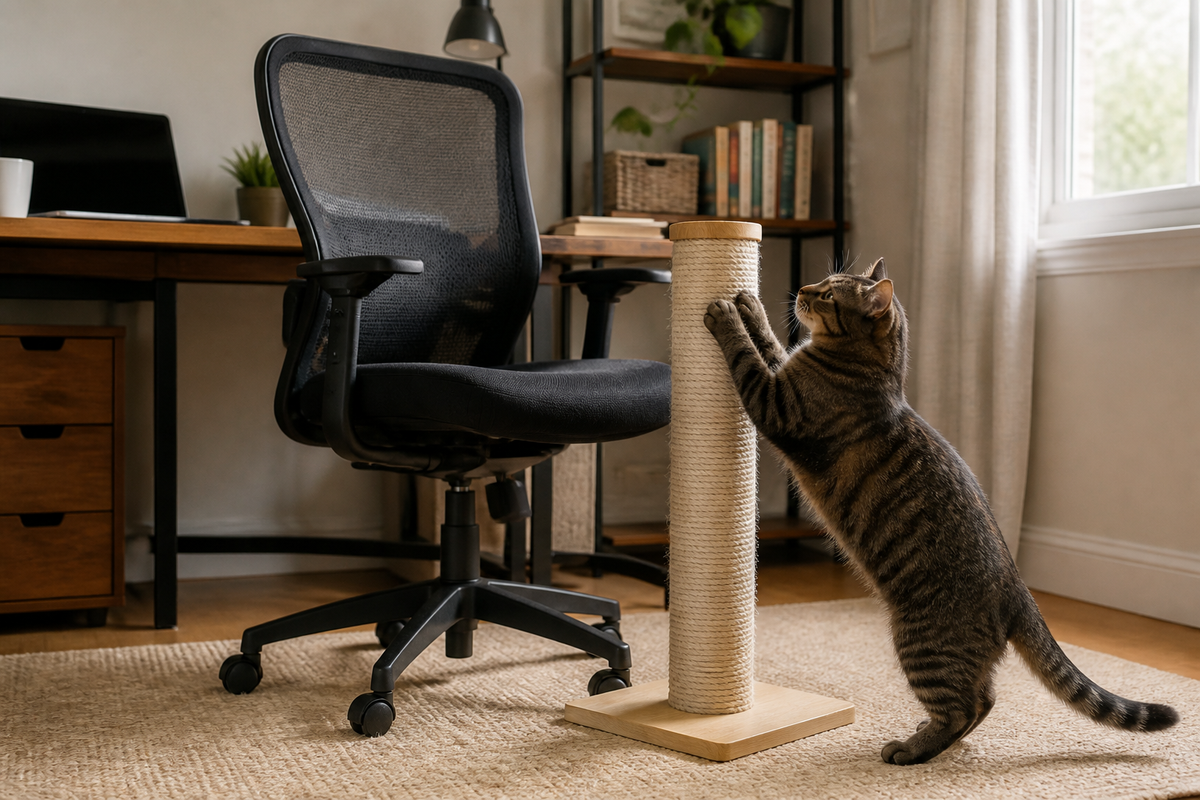
A chair-safe, cat-aware method for identifying why the chair is targeted, placing the right scratcher, protecting each material, and checking damage before reuse.
The right ergonomic setup should adapt to your body, support frequent movement, and stay comfortable through a full workday.
To protect an office chair from cats, put an acceptable scratching surface beside the part of the chair your cat targets, then shield or restrict access to the chair while that alternative becomes familiar. The goal is not to eliminate scratching. It is to redirect a normal feline behavior without damaging the chair, frightening the cat, or creating a loose-cover hazard around the casters and controls.
Start by watching what actually happens. A cat that rakes the side of a backrest needs a different solution from one that climbs the chair to reach a high perch. The Cornell Feline Health Center explains that scratching is an innate marking and claw-maintenance behavior. It recommends matching the replacement surface to the cat's preferred material and orientation, then placing it next to the current target.
Work out what the cat is using the chair for
Do not assume every claw mark is deliberate scratching. Observe the chair for a few days, or use a room camera if the damage happens when nobody is present. Note the height, direction, and location of new marks.
| What you observe | What the chair may be providing | Best first change |
|---|---|---|
| Long vertical marks on the back or side | A tall, stable surface for a full-body stretch | Place a sturdy vertical scratcher directly beside that area |
| Short horizontal marks on the seat edge | A low surface for horizontal scratching | Add a flat or inclined cardboard scratcher next to the chair |
| Claw punctures leading toward the top of the backrest | A climbing route to a high lookout | Provide a stable cat tree or perch nearby and block the climbing route temporarily |
| Kneading on the seat with little raking damage | A soft resting place carrying familiar scent | Offer a washable cat bed or folded blanket close to the workspace |
| Damage only when the chair is empty or the room is quiet | Unsupervised access to an established target | Cover or remove access to the chair whenever the workspace is unattended |
This distinction matters. A scratching post will not solve a climbing route if the chair remains the easiest way to reach a window, shelf, or warm desk surface. Likewise, a high cat tree may not satisfy a cat that prefers horizontal cardboard.
Put the approved scratching surface where the chair is
The replacement has to compete with the chair at the moment the cat wants to scratch. A post across the room may be a good cat accessory but a poor substitute for the backrest already in use.
- Match the orientation. Use a vertical post for upright raking, a horizontal pad for floor-level scratching, or both when the pattern is mixed.
- Match the usable size. The cat should be able to complete the same stretch without the scratcher sliding or tipping. Cornell recommends a sturdy post at least as tall as the cat standing on the hind legs with the front legs extended.
- Place it at the target. Begin immediately beside the scratched side of the chair, not in the location where you eventually want the scratcher to live.
- Reward the replacement. Calm praise, play, treats, or catnip may make the new surface more interesting when those rewards are appropriate for the individual cat.
- Wait before moving it. After the cat uses the scratcher reliably, move it in small increments if the original position obstructs the workspace.
Do not hold a cat against the post or drag its paws over the surface. The ASPCA's destructive-scratching guidance warns that forcing the interaction can frighten the cat and make the scratcher less appealing.
Protect the chair while the new habit forms

Redirection takes time, so give the chair a temporary physical barrier. Choose a method that can be removed cleanly and that does not alter the chair's support surfaces or mechanisms.
Use a removable cover when the chair is parked
A fitted chair cover or tightly placed washable throw can block access to fabric, faux leather, leather, or mesh while the chair is not in use. Smooth covers are often less satisfying to rake than exposed upholstery, but the fit matters more than the material name. Remove the cover before sitting, adjusting, reclining, or rolling. No edge should hang near the casters, cylinder, levers, cables, or tilt mechanism.
Keep adhesive products off unknown chair surfaces
Cornell and the ASPCA both list double-sided tape as a possible furniture deterrent. An office chair adds a material problem: adhesive may leave residue, lift a coating, pull fibers, or change the feel of mesh or upholstery. If you use a labeled pet-safe adhesive deterrent, attach it to a separate removable guard or sacrificial cover—not directly to the chair—and keep it away from anything the cat could chew or swallow.
Restrict access when you cannot supervise
Closing the office door, parking the chair in a room the cat cannot enter, or temporarily turning the protected side toward a wall removes the target during the learning period. Cornell notes that restricting access is the only certain way to prevent scratching of one specific object. Make sure the parked chair cannot roll, tip, trap a paw, or block a required walkway.
Skip homemade scent deterrents
Do not spray essential oils, concentrated citrus mixtures, or an unknown cleaner on the chair. The ASPCA Animal Poison Control Center notes that cats are especially sensitive to essential oils and recommends avoiding them in accessible areas unless a veterinarian approves the use. A physical barrier and a better scratching option are easier to evaluate and less likely to conflict with chair-care instructions.
Match the barrier to the chair material
Chair material changes what can be covered, cleaned, or safely left alone. The model's care instructions always take priority over a generic furniture tactic.
| Chair area | Low-risk protection while parked | What to avoid | Damage that needs closer review |
|---|---|---|---|
| Mesh back or seat | A smooth removable cover that does not pull on the mesh frame | Tape on the mesh, pins, clips under tension, or improvised stitching | Broken strands, a detached edge, loss of tension, or exposed frame |
| Woven fabric | A fitted washable cover with no trailing ties | Unknown adhesive, soaking, or a strongly scented spray | Open seams, exposed foam, or a tear that continues to spread |
| Leather or faux leather | A smooth nonadhesive cover removed before use | Sticky tape, household solvents, or an unapproved coating | Deep cuts, lifted layers, exposed padding, or damage at a load-bearing seam |
| Plastic frame and arm pads | A guard that leaves controls, joints, and moving gaps open | Wrapping a recline joint, lever, fastener, or ventilation opening | A crack, sharp edge, looseness, or change in normal movement |
For routine surface care, follow the material checks in OdinLake's office-chair cleaning guide. Cleaning can remove loose fur, soil, or compatible residue; it cannot restore torn load-bearing mesh, a damaged seam, or a cracked component.
Do not create a new chair or pet safety problem
- Remove every temporary cover or guard before someone sits, rolls, reclines, or adjusts the chair.
- Keep fabric, ties, tape backing, plastic film, toys, and scratcher debris clear of casters and moving mechanisms.
- Do not attach a scratcher to the backrest, armrests, headrest, cylinder, or base unless the chair manufacturer expressly designed that attachment point.
- Do not use sharp, abrasive, unstable, electrified, or motion-triggered devices around a rolling chair.
- Remove any barrier that the cat chews, tears into small pieces, or becomes tangled in. Contact a veterinarian promptly if ingestion or injury is suspected.
- Stop using the chair if scratching reveals foam, creates a sharp edge, loosens a component, separates mesh from its frame, or changes the chair's stability or controls.
The safest protection setup works only while the chair is parked. It should never become a permanent layer that changes seat fit, conceals damage, blocks a control, or enters the wheel path.
If the cat keeps returning to the chair
Repeat the observation rather than adding stronger punishment. The cat may prefer a different scratching angle, a firmer base, a rougher texture, or the exact location where people spend time.
- Move the scratcher back against the chair if it was relocated too soon.
- Add the missing orientation: a flat pad beside a vertical post, or vice versa.
- Provide a stable nearby perch if the marks come from climbing rather than raking.
- Keep the chair inaccessible whenever nobody can redirect the behavior.
- Reward use of the approved scratcher and leave a well-used post in place; familiar wear can make it more attractive.
Avoid yelling, spraying water, or physically forcing the cat away. Cornell explains that punishment can make the cat fear the person without teaching a reliable alternative. If scratching changes suddenly, becomes intense, occurs with other behavior changes, or does not improve despite a consistent setup, ask a veterinarian or qualified feline behavior professional for an individual assessment.
Inspect the chair before putting it back in service
- Remove the protective cover and all loose fibers, tape backing, cardboard, and cat hair from the floor and chair exterior.
- Check the scratched area in bright light. Look for a spreading tear, detached mesh, open seam, exposed foam, cracked frame, loose arm, or sharp edge.
- With the chair unloaded, verify that the casters rotate normally and that no cover material entered the wheel guards.
- Operate only the normal user controls and confirm that the chair behaves as its current manual describes.
- If damage affects a support surface, mechanism, joint, or stability, keep the chair out of service and contact the manufacturer rather than hiding the area under a cover.
OdinLake owners can use the current OdinLake Help Center to confirm care or service options for the exact chair model. If a damaged chair cannot be safely restored, compare the verified materials, dimensions, controls, and support terms in the OdinLake ergonomic chair collection instead of assuming any upholstery is “cat-proof.”
Frequently Asked Questions
Why does my cat scratch my office chair?
Scratching is a normal feline behavior used for marking, stretching, and maintaining the claws. An office chair may offer the preferred height, texture, stability, or location. Observe whether the cat is truly scratching, climbing to the backrest, or kneading the seat before choosing a solution.
What kind of scratching post should I put beside an office chair?
Match the cat's existing pattern. Use a tall, stable vertical post for upright backrest scratching and a horizontal or inclined pad for seat-edge or floor-level scratching. Place it directly beside the targeted area until the cat uses it consistently.
Can double-sided tape stop a cat from scratching an office chair?
It may make a surface less attractive, and both Cornell and the ASPCA include it among possible furniture deterrents. Do not assume the adhesive is safe for mesh, leather, faux leather, fabric, or coatings. Apply a labeled pet-safe product to a separate removable protector, keep it out of chewing reach, and never block controls or moving parts.
Should I spray my office chair with a cat deterrent?
Avoid homemade essential-oil or concentrated fragrance sprays. Cats can be sensitive to these substances, and the chair material may also react. Prefer a physical cover, restricted access, and a better scratching surface; use a commercial product only when its label, veterinarian guidance, and the chair's care instructions all permit it.
Will a chair cover protect mesh or leather from cat claws?
A removable cover can reduce direct access while the chair is parked, but it is not a repair or a guarantee. Choose a smooth, nonadhesive cover that does not pull on mesh or trap moisture against upholstery. Remove it completely before using or moving the chair.
What should I do if my cat has already damaged the office chair?
Clean only according to the material instructions, then inspect the chair rather than covering the damage immediately. Cosmetic marks and load-bearing damage are different: torn support mesh, open structural seams, cracks, looseness, sharp edges, or changed controls require service review. Keep the chair out of use until its stability and normal operation are clear.