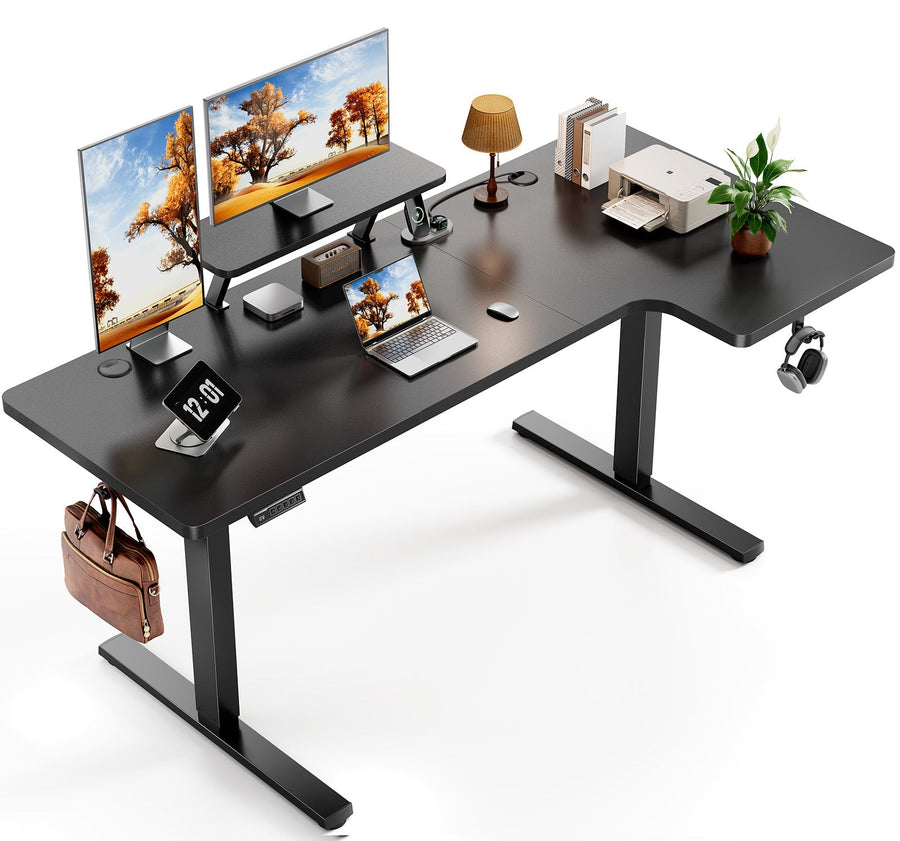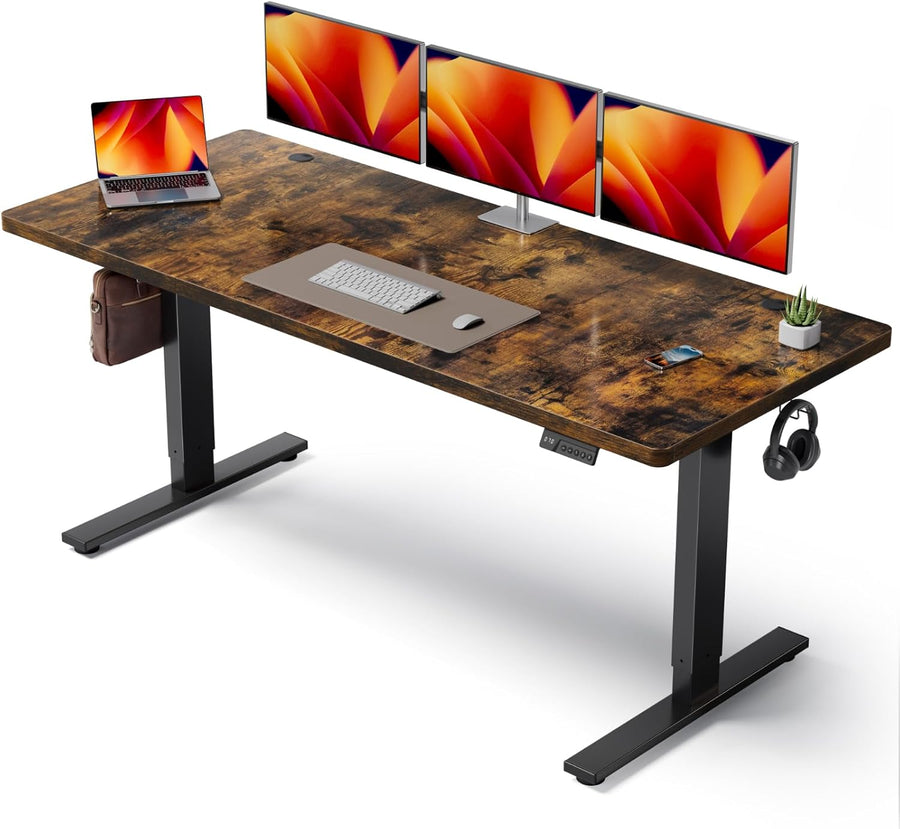
A conditional safety guide for checking desk instructions, surge-protector ratings, shared loads, direct wall connections, and moving cable clearance.
The right ergonomic setup should adapt to your body, support frequent movement, and stay comfortable through a full workday.
You can plug a standing desk into a surge protector only when both products allow that connection. The desk’s current instructions must permit it, the surge protector must be grounded and correctly rated, and the total connected load must stay within every applicable limit. If the desk manual says to use a wall outlet, the power accessory has no readable rating, or the outlet is loose, hot, or repeatedly trips, do not improvise.
This is not a decision you can make from the number of outlets or a “protected” light alone. Treat the standing desk, surge protector, wall receptacle, and every other connected device as one power path, then verify that path before you run the desktop through its full travel.
Practical rule: use a suitable grounded wall outlet when the desk requires one. Use a surge protector only when the desk maker and the protector’s listing and instructions permit the arrangement, the shared load is verified, and the moving cable remains slack and protected at every desk height.
The decision belongs to both instruction sets
A motorized desk is electrical equipment with a moving structure. Its label or manual may specify input voltage, frequency, current, grounding, indoor-use conditions, and where the plug should connect. The surge protector has a separate label that governs its maximum load, grounding, environment, mounting, replacement, and connection rules. Meeting only one set of instructions is not enough.
Start with the current manual for the exact desk model and revision. An OdinLake product page can help identify the model, but it should not be used to invent an electrical requirement that is not published there. For an OdinLake desk, use the current assembly resources and ask OdinLake support when the label or instructions do not answer the connection question.
Write down these fields before choosing a power path:
| Check | Where to find it | What must be clear |
|---|---|---|
| Desk input | Desk label and current manual | Voltage, frequency, current or power, grounding, and any direct-wall requirement |
| Surge protector rating | Protector label and instructions | Maximum current or load, voltage, grounded use, permitted environment, and connection limits |
| Other connected equipment | Each device label or power supply | The load added by computers, monitors, chargers, lamps, and other equipment |
| Wall receptacle | Visible condition and facilities or electrician review | A firm, correctly configured grounded receptacle with no heat, damage, or repeated tripping |
If a required field is missing or unreadable, pause. A generic internet wattage estimate is not a substitute for the exact model label or manufacturer guidance.
A power strip and a surge protector are not the same
A basic power strip primarily adds receptacles. A surge protector is designed to limit certain transient overvoltage events for connected equipment. The two can look similar, so appearance and outlet count do not establish protection. The Electrical Safety Foundation International’s surge-protection guidance makes the same distinction and notes that point-of-use protection has limits.
Protection does not increase electrical capacity
Surge protection does not make an overloaded strip acceptable, repair poor building wiring, stabilize a loose receptacle, or give a desk more power than its instructions allow. It also does not guarantee protection from every event, including a direct lightning strike. A higher joule number may describe one aspect of surge capability, but it does not answer the desk-compatibility, shared-load, grounding, or cable-travel questions.
Create one-source power map

Sketch the connection in one line before plugging anything in:
Permanent grounded wall receptacle → permitted surge protector → standing desk and any other approved loads
Do not create a chain of power strips, surge protectors, or extension cords just because the desk cord cannot reach. In its interpretation for listed relocatable power taps, OSHA explains that the tap is connected directly to a permanently installed branch-circuit receptacle rather than series-connected to another tap or an extension cord. The exact product label and local workplace rules still control your setup.
If the intended wall receptacle cannot be reached while preserving safe cable slack, redesign the layout or have a qualified electrician or facilities team provide an appropriate receptacle. Moving the desk closer to a verified outlet is a better answer than hiding an unapproved chain under the desktop.
Count the whole shared load
The standing desk is not the only device that matters. A computer, displays, charging bricks, speakers, lamps, and heaters can all share the same accessory or circuit. Compare the combined connected load with the lowest applicable rating in the entire path. Do not assume that “one desk plus one computer” is universally safe; power supplies, desk motors, accessories, and manufacturer restrictions vary.
If the labels do not provide comparable information, or if you are unsure how a motor’s startup demand affects the accessory, ask the desk manufacturer, surge-protector manufacturer, facilities team, or a qualified electrician. Do not test an uncertain load by waiting to see whether something trips.
Run a full-travel cable test
A power arrangement can be electrically acceptable at sitting height and still fail mechanically when the desktop rises. The goal is not merely to make the desk move once; the cord must remain clear, slack, and undamaged across the full usable range.
- Inspect before energizing. With connected equipment switched off, check the desk cord, plug, protector, and visible receptacle for cuts, crushed insulation, bent blades, discoloration, loose parts, or contamination. The OSHA electrical-equipment use rules call for damaged flexible cords and connected equipment to be removed from service rather than used until they fail.
- Place the permitted protector without tension. Keep the protector and its cord away from lifting columns, crossbars, hinges, pinch points, sharp edges, chair casters, and walking paths. Leave controlled slack for the desktop’s highest position without creating a loose loop that can snag.
- Restore power with the travel area clear. Keep hands, pets, cables, storage, and chair parts away from the moving structure. Move the desk slowly upward while watching the entire cable path.
- Stop at the first sign of strain. If a cable becomes taut, lifts the protector, rubs a sharp edge, enters a pinch point, or pulls at a plug, release the control and lower the desk enough to remove the tension. Reroute before continuing.
- Check the downward path. Lower the desk while watching for loops that fold into the frame, land under a foot, drag across a caster path, or become trapped behind furniture.
- Repeat with the real workstation connected. Confirm that monitor, computer, and accessory cables follow the same safe path. Save or use standing-desk presets only after the route works at both extremes; the OdinLake preset guide explains how to verify working heights without treating a stored number as proof that the surrounding setup is safe.
The successful observation is simple: nothing pulls, pinches, rubs, lifts, rolls over, or blocks movement from the lowest tested position to the highest. If the route cannot meet that condition, the connection is not ready for routine use.
Mounting a surge protector under the desk changes the test
An under-desk position can keep plugs off the floor, but it also moves the protector with the desktop and changes how much wall-cord travel is required. Mount it only when both the protector and desk instructions permit that location and method.
- Keep the switch, protection indicator, plug connections, and label visible and reachable.
- Preserve any required ventilation and clearance.
- Use only an approved mounting feature or method; do not drive improvised screws through the housing or staple a flexible cord.
- Support connected cables so their weight does not pull plugs partly out of the protector.
- Re-run the full-travel test after mounting and after any desk, monitor, or computer is moved.
If the protector is not designed for mounting, keep it in a stable, dry, accessible location that does not create a trip, caster, or pinch hazard. Do not conceal it where heat, damaged plugs, or a failed protection indicator would be difficult to notice.
Use a conditional yes-or-no decision
| Observed condition | Decision |
|---|---|
| Both instruction sets permit the connection; ratings, grounding, shared load, and full travel are verified | A surge protector can be a reasonable connection for that setup |
| The desk instructions require a suitable wall outlet | Plug the desk into that wall outlet and follow the manual |
| The protector is only a basic strip, has an unreadable label, or has no clear protection-status guidance | Do not treat it as verified surge protection; replace or confirm it before use |
| The combined load cannot be verified | Do not guess; obtain model-specific guidance |
| The layout requires daisy-chaining or an unapproved extension cord | Change the layout or obtain an appropriate permanent receptacle |
| A receptacle, plug, cord, or protector is loose, damaged, unusually hot, discolored, buzzing, arcing, or repeatedly trips | Stop, disconnect if it is safe to do so, and use qualified support |
Know when the power accessory is not the fix
A surge protector cannot correct a defective outlet, undersized or damaged building wiring, water exposure, a desk fault, or a cable that is too short for the travel range. It also is not an uninterruptible power supply. If backup power is the goal, the UPS manufacturer must explicitly support the desk’s type of load and connection; do not assume that a computer UPS accepts a motorized desk.
Stop using the setup if you notice a burning odor, smoke, arcing, melted or discolored plastic, repeated breaker or protector trips, a plug that will not remain firmly seated, damaged insulation, or abnormal desk resets associated with the connection. Do not open the protector, receptacle, desk control box, or damaged wiring. In a workplace, report the condition to facilities or the employer’s electrical-safety owner; at home, use the relevant manufacturer and a qualified electrician.
For general model browsing, the OdinLake standing desk collection identifies current desk families. The exact product label, current manual, and support response—not the collection page—should determine the final electrical connection.
Frequently Asked Questions
Does a standing desk need a surge protector?
Not every standing desk has a universal surge-protector requirement. Follow the exact desk manual and local electrical requirements. If the instructions permit a surge protector, verify its grounding, rating, shared load, condition, and full-travel cable route before use.
Can I plug a standing desk into a regular power strip?
Only when the desk and the listed power strip both allow that use and the complete load and connection path meet their ratings. A regular power strip may add outlets without providing surge protection, so do not treat the two products as interchangeable.
Can a standing desk and computer share one surge protector?
They may share one only when every manufacturer permits it and the combined connected load remains within the lowest applicable rating. Check the desk, computer power supply, displays, chargers, and every other connected device; do not rely on a generic desk-and-PC estimate.
Is a power strip the same as a surge protector?
No. A basic power strip primarily provides additional receptacles, while a surge protector is designed and labeled for limited transient-overvoltage protection. Neither product increases the capacity of the wall circuit or makes an overload safe.
Can I plug a surge protector into an extension cord?
Do not assume that arrangement is permitted. Common listed relocatable power taps are intended to connect directly to a permanent receptacle, and OSHA warns against series connections. Follow the exact labels and local rules; if the desk cannot reach safely, change the layout or obtain an appropriate receptacle.
Can I mount a surge protector under a standing desk?
Only when the protector and desk instructions permit the mounting method and location. Keep the unit ventilated, accessible, undamaged, and supported, then test the wall cord and every connected cable through the desk’s full travel. If any cord tightens, snags, pinches, or pulls a plug, stop and reroute it.