A measurement-first guide to separating item weight, package weight, component weight, and user capacity—then verifying the number needed for moving or shipping.
The right ergonomic setup should adapt to your body, support frequent movement, and stay comfortable through a full workday.
There is no single weight for an office chair. The number you need is the assembled item weight for the exact model and configuration—not the chair’s user weight capacity and not the weight of its shipping carton. Current OdinLake product pages checked on September 5, 2026, list examples from 55 pounds for the L2 to 68 pounds for the O1 and O3. That 55–68-pound span is a transparent sample of three OdinLake models, not a market-wide average.
For a move, staircase, vehicle, or shipping plan, verify the current specification or weigh the empty chair on a stable platform scale. Record the source, date, configuration, and units. If the chair is too bulky to place on a suitable scale without awkward lifting or unstable balancing, use a shipping store, warehouse scale, or professional mover instead.
Four Different Numbers Can Be Called “Chair Weight”
A product page, carton, marketplace listing, and carrier label may show different numbers while all referring to the same chair. Before comparing them, identify what each number includes.
| Number | What it usually describes | Use it for | Do not use it for |
|---|---|---|---|
| Assembled item weight | The empty chair in its specified assembled configuration | Handling, room-to-room moves, stairs, vehicle loading, and comparing chair configurations | Estimating the sealed shipping carton unless packaging is added separately |
| Package or gross weight | Chair parts plus carton, inserts, hardware, manuals, and included accessories | Receiving, warehouse handling, and carrier declarations for the sealed package | Describing how heavy the assembled chair feels in use |
| Component weight | A removable seat assembly, backrest, base, or other documented subassembly | Planning model-approved disassembly and the heaviest individual lift | Assuming every chair can be separated into the same pieces |
| User weight capacity | The maximum supported user load stated by the manufacturer under its conditions | Fit and load-limit screening | Estimating the chair’s own mass; a 350-pound capacity does not mean the chair weighs 350 pounds |
“Net weight” can sometimes mean item weight, but labels are not perfectly standardized across sellers and logistics systems. Read the field definition instead of trusting the word net alone. Also confirm whether an optional headrest, footrest, or accessory is included. Two listings for the same base model may describe different configurations.
Use Exact Model Data, Not a Generic Average
Start with the manufacturer’s current product page, specification sheet, manual, carton label, or order record. Match the complete model name and variant. A family name is not enough when one version adds a footrest or uses a different frame.
The following examples show why a single office-chair average is not a safe planning value. They are current first-party specifications, checked on September 5, 2026; availability and specifications can change, so recheck the source before a real lift or shipment.
| OdinLake model | Published item weight | Published weight capacity | What the comparison proves |
|---|---|---|---|
| L2 (Ergo PRO 633) | 55 lb (about 24.9 kg) | 300 lb / 136 kg | The chair’s own weight and its supported user load are separate specifications. |
| O1 (Ergo PLUS 743) | 68 lb (about 30.8 kg) | 350 lb / 158 kg | A specific item-weight field is more useful than a broad category estimate. |
| O3 (Ergo BUTTERFLY 753) | 68 lb (about 30.8 kg) | 350 lb / 158 kg | Two chairs can share an item weight without having identical construction or adjustments. |
This small brand sample is useful for verifying named products, but it cannot support a claim about the “average office chair.” A defensible market average would require a defined market, a representative model set, consistent configurations, and the same weight field for every chair. Search-result ranges rarely disclose that method.
Create a four-number weight record
For a chair you own, record these four fields in one note: assembled item weight, package weight if known, heaviest removable subassembly if the manual identifies it, and user weight capacity. Add the model, variant, source URL or label photo, units, and date checked. Use “not published” rather than copying a number from a similar-looking chair.
How to Weigh an Office Chair Safely
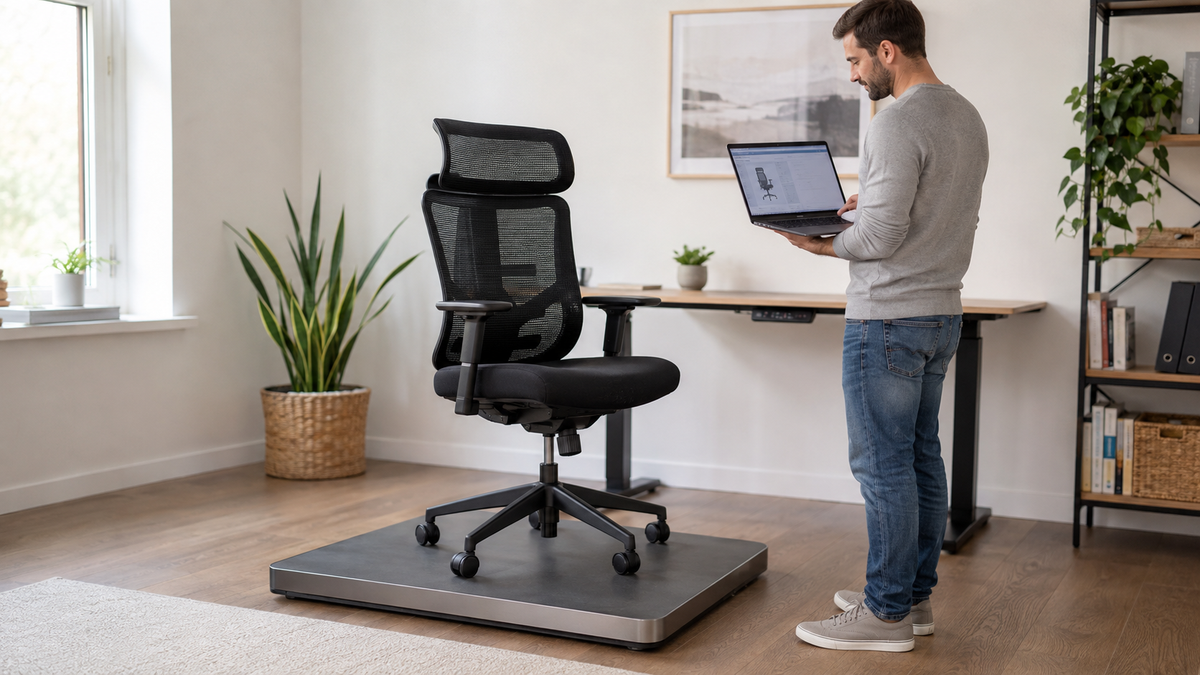
Weighing should resolve uncertainty, not create a lifting or tipping hazard. The best setup is a certified or recently verified low-profile platform scale with a surface large enough to support the entire five-star base. Its rated capacity must exceed the expected chair weight, and the display should remain readable after the chair is placed.
- Empty the chair. Remove bags, cushions, loose accessories, and anything stored on the seat. Keep factory-installed options in place if you want the assembled configuration’s weight.
- Identify the scale and its limit. Check its operating instructions, capacity, resolution, required surface, and tare function. Place it on a hard, level floor.
- Check the footprint. All five casters must remain fully supported. Do not balance a base across several household scales or let wheels sit on the platform edge.
- Zero the complete setup. If a manufacturer-approved flat platform or ramp is required, put it in place before taring. Do not improvise with a flexible board that can bow or slide.
- Prepare the chair. Lower adjustable parts and return the backrest near upright. Retract a footrest and other extensions according to the manual. Do not remove the gas cylinder or structural parts merely to make weighing easier.
- Load without an awkward lift. Use the scale’s approved ramp or handling procedure. If the chair must be lifted, the load is bulky, or the route requires twisting, get appropriate help or use professional equipment.
- Let everything settle. Make sure the chair is empty, upright, motionless, and not touching a wall, desk, cable, or person. Record the stable reading and units.
- Repeat once. Remove the chair, confirm the scale returns to zero, and repeat. A meaningful mismatch signals movement, contact, poor support, or an unsuitable scale.
A bathroom-scale subtraction method—person alone, then person holding the chair—looks convenient but asks someone to grip a large irregular object while reading two measurements. It also combines scale error and can exceed the scale’s intended use. Do not use that method when the chair blocks vision, shifts its center of mass, forces the arms away from the body, or requires stepping onto a scale while loaded. A professional platform scale is the better fallback.
Stop instead of forcing a measurement
Stop if a caster cannot be fully supported, the platform moves, the chair begins to roll or tip, your grip is uncertain, the path is cluttered, or the scale’s rating and instructions are unknown. Also stop if the chair has a cracked base, loose structural connection, damaged caster socket, or suspect gas lift. A weight reading does not make a damaged chair safe to handle or use.
Weight Alone Does Not Tell You Whether One Person Should Lift It
An office chair is an awkward load: the base is wide, casters rotate, armrests and headrests project outward, and the useful grip points may be far from its center of mass. The Occupational Safety and Health Administration explains that weight alone does not determine lifting risk. Frequency, bending or twisting, lift height, starting height, distance from the body, holding time, and grip all affect the task.
The Revised NIOSH Lifting Equation likewise evaluates more than object weight, including horizontal and vertical hand location, travel distance, asymmetry, frequency, duration, and coupling quality. It was designed for defined two-handed lifting tasks; the application manual notes limitations for unstable loads and constrained spaces. A rolling chair on a staircase is therefore not reduced to a universal “safe pounds per person” rule.
| Observed condition | What it changes | Safer decision |
|---|---|---|
| Level, clear route and an intact chair that rolls normally | May avoid lifting for a same-floor move | Guide the empty chair slowly; control thresholds and cables. |
| Narrow doorway, sharp turn, or vehicle opening | Forces the load away from the body or into rotation | Measure the route first and use the office-chair transport procedure. |
| Stairs, poor grip points, damaged parts, or a shifting footrest | Raises the consequences of a loss of control | Use trained help or suitable moving equipment; do not improvise. |
| Model-approved removable parts | Can reduce bulk and individual component weight | Follow the exact manual and keep hardware labeled; do not assume the gas lift is user-removable. |
Use the Right Weight for the Real Task
For moving: combine assembled item weight with overall width, height, depth, grip points, route, and destination. Lowering the seat may reduce size but does not materially change weight. Decide whether model-approved disassembly is necessary only after measuring the narrowest opening.
For stairs: the listed weight is only one input. The person below the chair may face a different share of the load, the base can catch a railing, and a rotating caster can change control. Treat stairs as a planned handling task, not a strength test.
For shipping: weigh the complete packed carton, not the bare chair. Packaging, detached parts, and accessories add mass. Carriers may also calculate dimensional weight from the package’s size. UPS explains that dimensional weight reflects the space a package occupies relative to its actual weight; use the carrier’s current rules and service limits rather than a saved divisor or an assembled-chair estimate.
For floors and mats: chair weight is not the entire applied load. Add the occupant and normal items, then use the floor, mat, and caster manufacturers’ compatibility and load guidance. Do not assume a lighter chair is harmless to a finish or that a heavier chair automatically needs one particular mat thickness.
Why Some Office Chairs Are Heavier
Item weight can increase with a larger frame, metal structure, a substantial tilt mechanism, integrated controls, adjustable back sections, a footrest, larger arm supports, or extra hardware. It can also change with materials and configuration. Those factors explain mass; they do not by themselves prove durability, comfort, safety, or value.
Likewise, a heavier chair is not automatically more stable. Stability depends on geometry, base dimensions, load distribution, component condition, assembly, caster behavior, floor level, and how the chair is used. Certification, manufacturer documentation, fit, adjustment range, and condition are better evidence than weight alone.
Frequently Asked Questions
How heavy is an average office chair?
There is no defensible universal average without a defined market and a representative, consistently measured sample. Use the exact model’s assembled item weight. For context only, three current OdinLake model pages checked on September 5, 2026, list 55 to 68 pounds; that is a brand sample, not an industry average.
How much does an ergonomic office chair weigh?
It depends on its frame, mechanism, adjustment system, accessories, and configuration. The current OdinLake L2 page lists 55 pounds, while the O1 and O3 pages list 68 pounds. Verify the exact chair because a similar design or shared weight capacity does not establish item weight.
Why are office chairs so heavy?
Full-featured chairs may include metal frames, multi-part backrests, tilt mechanisms, gas lifts, adjustable armrests, headrests, and footrests. These can add mass and make the shape awkward to grip. Weight alone does not prove quality or stability.
Is chair weight the same as weight capacity?
No. Chair or item weight describes the empty chair. Weight capacity describes the maximum supported user load under the manufacturer’s conditions. Record them as separate fields and never substitute one for the other.
How can I weigh an office chair at home?
Use a rated, stable platform scale large enough to support all five casters, preferably with an approved ramp or loading procedure. Empty the chair, zero the setup, keep the chair upright and free of contact, record a stable reading, and repeat. If that requires awkward lifting or balancing, use a shipping store or professional scale.
Does a heavier office chair mean it is more stable or better?
No. Mass is only one specification. Stability and quality depend on design, base geometry, materials, construction, assembly, condition, testing, and correct use. Compare documented features and certifications instead of treating weight as a quality score.
The useful answer is not a guessed category average. Identify the exact chair, separate item weight from capacity and package weight, verify the current source or measure it on suitable equipment, and then plan the handling task around the chair’s size, route, grip, and condition.