The right ergonomic setup should adapt to your body, support frequent movement, and stay comfortable through a full workday.
Two chairs can both be called saddle chairs and fit completely different setups. A tall saddle stool may work at a raised craft bench but leave you sitting too high at a bedroom desk. Before you buy, check three things: the seat height you need, how the seat shape feels, and whether you want a backrest.
What is a saddle chair?
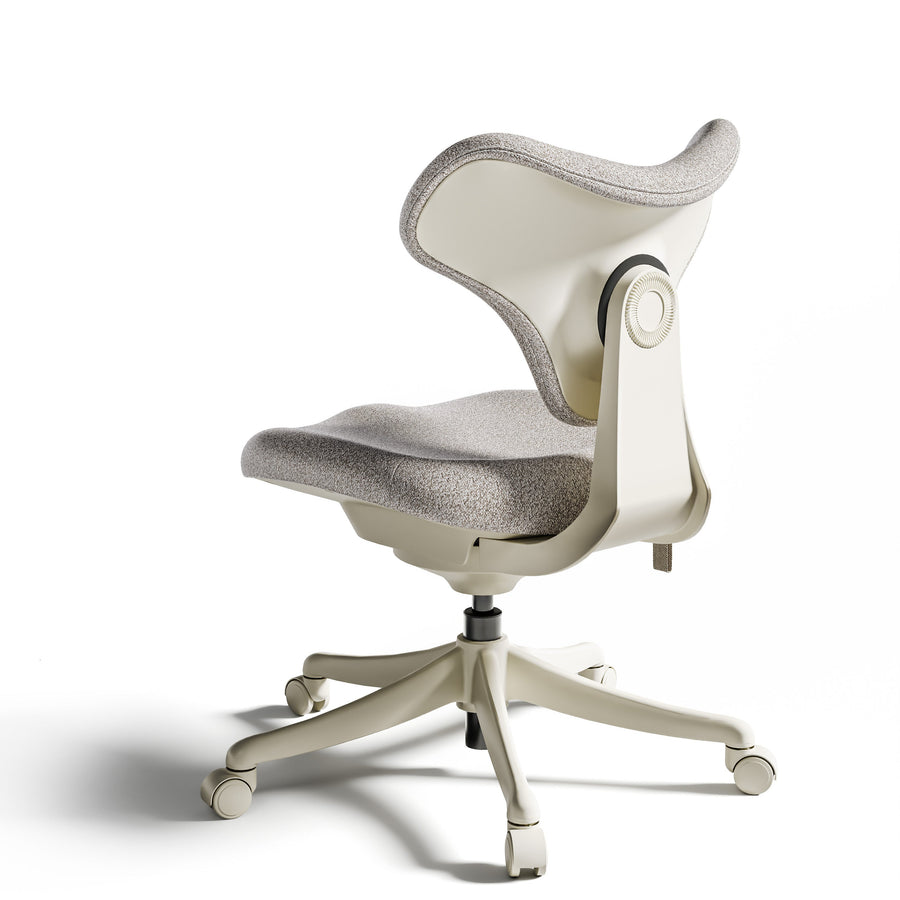
A saddle chair has a contoured seat inspired by a riding saddle. The shape gives your thighs room to angle down and out. Some models have a deeper contour and are designed to be straddled, while others, like the OdinLake C1 Arc, use a gentler saddle-inspired curve and come with a compact backrest. Learn about saddle seating.
Why do people like saddle chairs?
The appeal is easiest to see when you move around during a task. If you’re sketching, sewing, or reaching for supplies beside your desk, the shape of the seat gives you room to reposition your legs. A swivel model also lets you turn toward what you need without moving the whole chair.
A compact saddle chair can also work well in a room that serves several purposes. At a bedroom desk, you might use the same chair to answer emails, work on a craft project, and read in the evening. A small backrest gives you somewhere to lean when you pause.
Why do people buy the wrong saddle chair?
One easy mistake is to check the desktop height and overlook the minimum seat height. A stool that starts high may put you too close to the underside of the desk or leave your feet unsupported. Drawers and support rails can also take up space exactly where your thighs need to go.
Another is to judge the chair by how it feels as soon as you sit down. A deeper saddle can feel comfortable for a moment, then start pressing against your inner thighs as you work. And if you usually lean back while reading or listening on a call, you may miss having a backrest more than you expected.
How to choose a saddle chair
1. Measure your current chair and the space under your desk
Sit at your desk in the setup you use most. If you can type with relaxed shoulders and supported feet, measure from the floor to the top of your current seat. Use that number to narrow the search. Then measure from the floor to the lowest part of the desk your thighs pass under, including any drawer or support rail. Save both measurements before you start comparing models.
If you’re looking at the C1 Arc, OdinLake’s desk-fit guide lists a seat-height range of 17.3–20.5 inches. If your current chair feels right at 18 inches, for example, that falls within the C1 Arc’s range and gives you a starting point for a trial sit. The saddle contour can change where your legs rest, so check thigh clearance while seated. Check whether the C1 Arc fits your desk.
2. Test the seat shape while doing something you actually do
Bring a book, type a few lines, or reach to the side as you would for a drawer. Try a gently contoured seat if you like changing leg positions. If you prefer the higher, straddled position of a deeper saddle, check that you can sit with both feet supported and that the seat doesn’t press into your inner thighs as you work. Give yourself enough time to notice whether you keep shifting away from the same spot.
3. Choose a backrest and base that suit the room
Think about what you do between tasks. If you regularly sit back to read or listen, choose a model with a backrest you can reach comfortably. If you mostly move between a raised workbench and nearby shelves, a backless saddle stool may suit that routine. In a tight room, check that the base and casters clear the desk legs, then make sure there’s enough room to swivel and stand up.
| If this sounds like your setup | Start here |
|---|---|
| A bedroom desk for email, reading, and crafts | A compact saddle chair with a backrest, such as the C1 Arc |
| A raised bench where you frequently stand and sit | A taller saddle stool with a lift that suits the bench |
| A narrow desk with a low drawer | Compare seat-height range and thigh clearance before ordering |
| A workstation you use for long stretches of typing | Try the chair during a normal work session and check whether the support suits you over time |
Our pick for small home workspaces: OdinLake C1 Arc
Choose the C1 Arc if your desk does double duty and you want one chair for light work, reading, and creative projects. Its cushioned, saddle-inspired seat gives your legs room to shift. Its compact curved backrest gives you somewhere to lean between tasks, and the 360° swivel makes it easy to turn from your desk to the shelf beside it. Those features are especially useful at a bedroom desk or in a small creative corner where you use the same chair throughout the day.
If the seat-height range works with your desk and you have room to swivel and get up, the C1 Arc is the one we’d choose for that setup. Shop the OdinLake C1 Arc.