
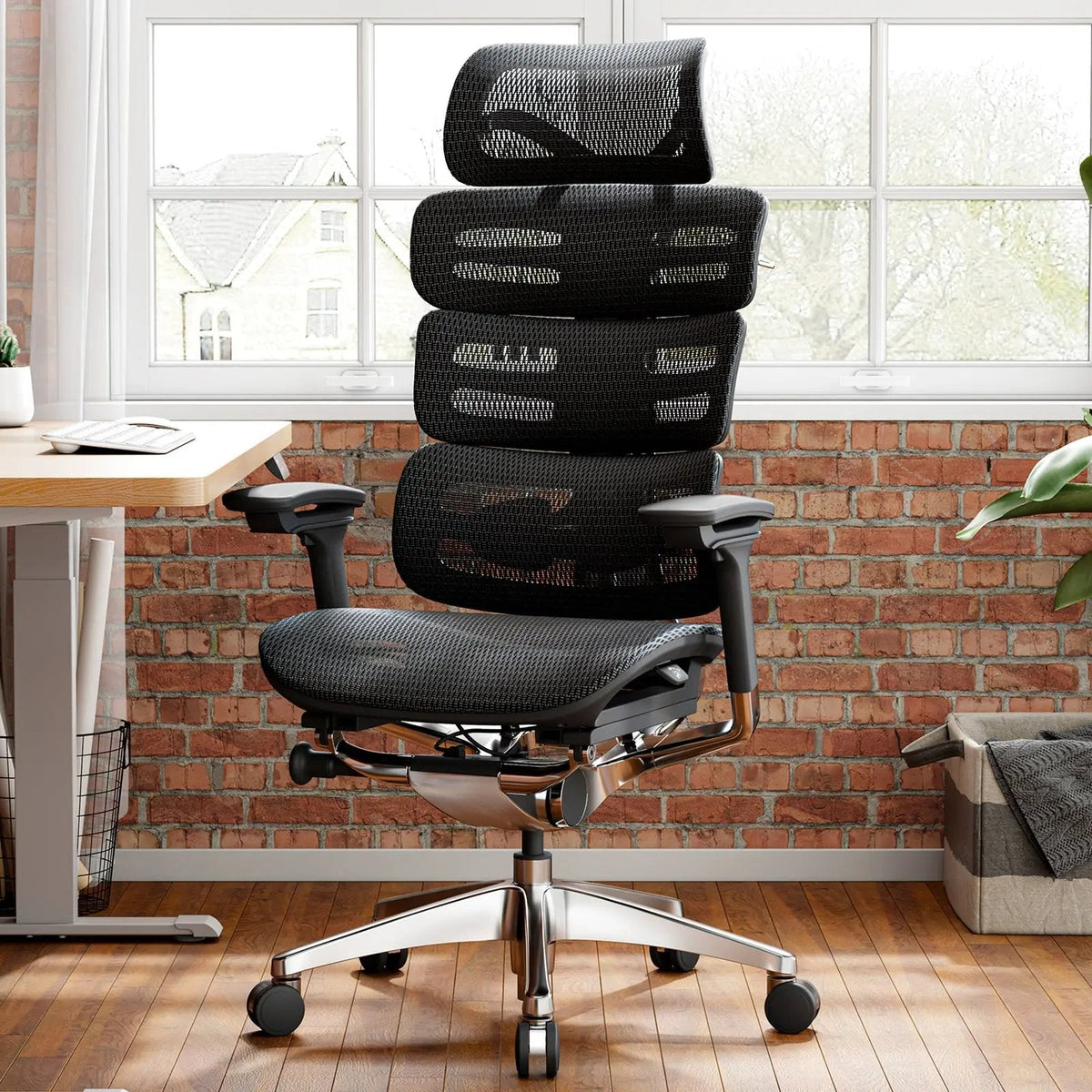
A parcel-shipping guide for packing an office chair, controlling box size, comparing carrier rules, and preserving damage-claim evidence.
The right ergonomic setup should adapt to your body, support frequent movement, and stay comfortable through a full workday.
To ship an office chair, choose the carrier and packing method before taking the chair apart. Photograph its condition, check the exact model's assembly instructions, remove only parts designed to detach, protect every component from contact, immobilize everything inside a strong box, seal it, and then measure and weigh the finished package. The final box—not the chair's advertised weight—determines whether a parcel service will accept it and what the shipment may cost.
Do not begin by forcing out the gas lift. Office chairs vary in construction, and a used pressure-fit cylinder may be difficult to separate safely. A smaller box is useful only when the disassembly is documented, the parts remain protected, and the carrier accepts the packaged contents.
Choose the shipping route before you buy a box
An office chair is awkward cargo: it is relatively heavy, occupies a large volume, and has vulnerable mesh, controls, arm supports, and projecting base legs. Start with the route that matches the packed size, value, and number of chairs rather than assuming ordinary parcel shipping will be cheapest.
| Situation | Route to price first | Main decision |
|---|---|---|
| One chair with intact original packaging | Ground parcel service | Does the complete box remain within the selected service's size and weight limits? |
| One chair without a reliable box or model-specific packing plan | Professional pack-and-ship service | Is the packing charge justified by the chair's value and replacement difficulty? |
| A very large chair or a package over a parcel limit | Furniture carrier or freight service | Does the shipment need a pallet, crate, appointment, or liftgate? |
| Several chairs going to one address | Compare palletized freight with separate parcels | Which method protects the chairs and lowers the total delivered cost? |
| A low-value chair with a high long-distance quote | Compare shipping with local sale, donation, or replacement | Is shipping economically sensible after packing and surcharges? |
Do not purchase a label from an estimated chair size. First use the manual and a preliminary layout to see what can be packed, then get a provisional quote. Buy the final label only after the box is sealed and remeasured.
Record what you are shipping
Before wrapping anything, identify the manufacturer, model, serial or order reference, and any separately purchased accessories. Save the current manual or assembly instructions. For an OdinLake chair, start with the official assembly page; if the exact model instructions or required hardware are unclear, use OdinLake support rather than treating another chair's video as interchangeable.
Photograph the chair from the front, rear, both sides, and underneath. Include close views of existing scratches, bent pieces, loose casters, or damaged mesh. Then test height, swivel, recline, locks, armrests, and casters. This creates a pre-shipment condition record and prevents an existing fault from being mistaken for transit damage.
Clean loose grit from hard surfaces and let every cleaned area dry. Tape and cushioning can trap moisture, while dust caught beneath wrap can rub against a finish. Remove personal accessories and empty any attached pouch or storage compartment.
Disassemble only at documented connections
The best packing configuration is often close to the way the manufacturer originally shipped the chair, provided the original materials are still sound and belong to that exact model. If the original box and molded supports are unavailable, use the assembly instructions to identify ordinary bolted or clip-in connections that are meant to be serviced.
- Lower and retract adjustments. Put the seat, headrest, armrests, lumbar module, and footrest in their most compact normal positions when the model allows it.
- Remove loose accessories. Detach only cushions, hangers, or accessories designed for routine removal.
- Photograph each approved connection. Record orientation, washer order, cable routing, and which fastener belongs where before loosening it.
- Separate documented removable parts. A backrest, headrest, arm assembly, or caster may be removable on one model and integrated on another. Follow the exact manual.
- Bag hardware by connection. Use separate sealed bags and label them without placing adhesive directly on upholstery or finished surfaces.
- Stop at resistance or an undocumented part. Do not pry, strike, heat, drill, or clamp a pressure-fitted, cable-connected, or structural component to make the carton smaller.
The gas lift needs particular care. It is a sealed pressure component, not ordinary scrap metal. PHMSA explains that certain gas springs can qualify for an exception from U.S. hazardous-material regulation only when specific design criteria are met, and it also states that correct classification is the shipper's responsibility. An owner normally cannot verify those engineering criteria from appearance alone. If a gas lift would be detached or shipped separately, ask the manufacturer and carrier to confirm acceptance and documentation before packing it; do not assume that “nitrogen-filled” means unrestricted. See the PHMSA gas-spring interpretation for the regulatory boundary.
Protect each component before it enters the box

Use clean packing paper or a nonabrasive sleeve as the first layer on delicate mesh, fabric, coated metal, plastic, leather, or soft arm pads. Add closed-cell foam, corrugated edge guards, or suitable cushioning outside that surface layer. Do not put packing tape directly on the chair.
Give special protection to projecting and load-sensitive areas:
- backrest and headrest edges;
- mesh panels and lumbar mechanisms;
- arm pads, arm supports, and control paddles;
- seat corners and exposed metal brackets;
- caster stems and wheel forks; and
- any model-approved detached cylinder or base connection.
Wrap each detached part separately so metal cannot rub against mesh and hardware cannot migrate into a mechanism. Keep fastener bags inside a small inner carton or secure them to a protected rigid part. Do not place a bag of bolts loose beside the seat.
Build the smallest box that still protects the chair
A box that is too small leaves no crush space; a box that is too large increases movement and can raise dimensional weight. FedEx's current furniture-packing guidance recommends wrapping the furniture first, then choosing a box that allows roughly 3–5 inches around the measured item for padding. Treat that as carrier guidance, not a universal specification for every chair or packaging system.
Use a new, strong corrugated carton rated for the packed load. For a heavy chair, generic lightweight moving boxes may not have enough stacking or puncture resistance. If one carton cannot safely support the load, use a professional packer, an engineered carton with fitted foam, a crate, or freight rather than nesting improvised boxes without a tested plan.
Pack the heaviest, most rigid pieces where they cannot crush the seat, mesh, controls, or arm pads. Create corrugated partitions between components. Fill every void with material appropriate to the weight; light loose fill alone can shift or compress beneath a dense metal base.
Before sealing, perform three checks:
- Contact check: no hard part can touch another hard or delicate surface through the cushioning.
- Movement check: a gentle controlled push or tilt does not let the contents slide, rotate, or strike the carton.
- Crush check: closing the flaps does not press on mesh, controls, protruding fasteners, or unsupported plastic.
The box must protect the chair even when orientation changes in transit. Do not rely on arrows or “this side up” wording to carry the load safely.
Seal, measure, and calculate the billable package
Seal the bottom and top with shipping-grade tape using an H pattern: close the center seam and both edge seams. FedEx's furniture guide specifies at least three strips of tape at least 2 inches wide on the top and bottom. Place the final label on the largest surface without crossing a seam, and remove or fully cover every old barcode and address.
Now measure the finished carton at its extreme points and weigh the complete package. Carrier rules below were checked on August 20, 2026; confirm the selected service and destination again when purchasing the label.
| Worksheet field | How to obtain it | Why it matters |
|---|---|---|
| Actual weight | Weigh the sealed package and follow the carrier's rounding rule | It may become the billable weight and can trigger heavy-package handling |
| Length | Measure the longest side | Carriers apply a maximum length |
| Width and height | Measure the other two sides at their widest points | They determine cubic size and girth |
| Length plus girth | Length + (2 × width) + (2 × height) | It is a common parcel-size limit and surcharge test |
| Dimensional weight | (Length × width × height) ÷ the current service divisor, then apply its rounding rule | The carrier may bill the greater of dimensional and actual weight |
UPS currently states that most U.S. small packages can weigh up to 150 pounds, measure up to 108 inches in length, and reach 165 inches in length plus girth, while specific routes can differ. Its package measurement guide also explains that dimensional weight may apply when a carton is large relative to its actual weight. UPS applies additional handling requirements to packages over 70 pounds, so use its current heavy-package instructions if that threshold is crossed.
FedEx's U.S. furniture page lists parcel options for furniture under 150 pounds and directs heavier shipments to freight. USPS uses different size rules by mail class; its current parcel size standards state that Ground Advantage packages may not exceed 130 inches in combined length and girth, with oversized pricing between 108 and 130 inches. These limits do not constitute a quote or guarantee of acceptance. Enter the sealed box, origin, destination, service speed, and contents into the chosen carrier's current system.
Compare the total charge, not just the base rate
The cheapest-looking service can become expensive after dimensional weight, additional handling, large-package, residential, pickup, remote-area, or address-correction charges. The quote also changes with distance and delivery speed. A useful comparison records the same final dimensions and weight for every carrier rather than using one estimated box for one quote and a different packed box for another.
For a bulky chair, box reduction matters only until it begins to reduce protection or require unsafe disassembly. FedEx explains that it charges the greater of actual and dimensional weight and currently uses a divisor of 139 for U.S., Puerto Rico, and international shipments. UPS publishes different dimensional divisors for some daily and retail rate types. Use the carrier calculator for the exact service instead of hard-coding one divisor into a shipping budget.
Also compare the chair's current replacement value with the complete shipping total. For a common chair, local transfer or replacement may be more economical. For a discontinued, high-value, employer-owned, or personally important chair, professional packing and adequate liability protection may be worth more than the lowest base rate.
Create a damage-claim evidence trail
Photograph every wrapped component, the internal partitions, the open packed box before closing, all six exterior faces after sealing, the label, and the reading on the scale. Save the receipt, tracking record, product proof of value, model information, serial number, and carrier terms that applied when the shipment was accepted.
Declared value is not automatically the same as third-party shipping insurance. FedEx, for example, describes a standard liability limit and an option to declare a higher value, while separately noting that insurance can be purchased from a third party. Read the chosen carrier's current liability, exclusion, packaging, and claim rules before deciding how much protection is appropriate.
Ask the recipient to photograph visible carton damage before opening. They should retain the box, cushioning, partitions, label, and damaged parts until the carrier releases them. After model-correct reassembly, test the chair empty on a level floor: verify caster seating, swivel, height movement, recline, locks, and visible structural connections. If it rocks, drops, binds, or shows a crack or bend, stop using it. OdinLake's wobbly-chair guide can help distinguish a floor or caster issue from a loose connection, but transit damage to a structural or pressure component belongs with manufacturer support and the carrier claim process.
Frequently asked questions
How much does it cost to ship an office chair?
There is no reliable flat price. The final charge depends on the sealed box's actual and dimensional weight, origin, destination, speed, residential or pickup services, surcharges, and declared value. Pack the chair first, then enter the same final measurements into each carrier's current quote tool.
What size box do I need to ship an office chair?
There is no standard chair box. Arrange only the model-approved detachable parts, wrap them, measure the protected bundle, and add the cushioning space required by the box design and carrier guidance. The smallest box is not acceptable if parts touch, move, or press against mesh and controls.
Should I disassemble an office chair before shipping it?
Disassemble only as far as the exact manufacturer's instructions support. Removing approved parts can reduce the box size, but forcing a pressure-fit cylinder, cable-connected mechanism, or structural joint can create damage and safety problems. Professional packing is the better option when the chair cannot be reduced safely.
Can UPS, FedEx, or USPS ship an office chair?
Potentially, if the sealed package meets the chosen service's current size, weight, contents, and destination rules. Many office-chair cartons are bulky enough for dimensional weight or oversize charges. Compare the finished package with each carrier's live limits before buying a label; use freight or a furniture carrier when parcel limits are exceeded.
Can I ship an office chair gas cylinder?
Do not assume a detached gas lift can be shipped as an ordinary metal part. Gas springs are pressurized, and any regulatory exception depends on specific design criteria that an owner may not be able to verify. Ask the chair manufacturer and carrier how the exact component must be classified, packaged, and documented; do not puncture, vent, heat, or open it.
Do I need insurance or declared value when shipping a chair?
Compare the carrier's standard liability with the documented replacement value and read its exclusions. Declaring a higher value can change the carrier's maximum liability but is not necessarily the same as buying insurance. Keep purchase records, condition photos, packing photos, and the complete carton until delivery and inspection are finished.


