Office chair wheels may share a common stem, but fit depends on the complete chair and workstation. Use this measurement-led compatibility check before ordering replacements.
The right ergonomic setup should adapt to your body, support frequent movement, and stay comfortable through a full workday.
No—office chair wheels are not truly universal. Many replacement sets use a widely sold press-fit stem, so the word “universal” can be useful shorthand. It is not a compatibility guarantee. A caster must match the chair’s attachment type, stem dimensions, retention method, installed height, base clearance, load requirements, and floor.
The safest route is an exact replacement part listed for the chair model. If that is unavailable, build a record from the existing caster before ordering. This guide covers that compatibility decision. It does not replace the chair maker’s removal or installation instructions.
A Caster Can Fit the Hole and Still Be the Wrong Wheel
“Does the stem enter the socket?” is only the first question. A replacement also has to stay retained, let the caster swivel without touching the base, preserve a usable seat-height range, carry the intended moving load, and behave appropriately on the floor.
| Compatibility field | What must match | What a mismatch can look like |
|---|---|---|
| Attachment type | Grip-ring, threaded, grip-neck, plate, or another documented mount | The caster cannot enter, cannot tighten, or has no way to remain retained |
| Stem dimensions | Diameter and usable length; thread diameter and pitch when threaded | The stem stops early, sits loose, or will not seat to the shoulder |
| Installed geometry | Overall mounted height and clearance through a full swivel | The chair sits higher, the housing contacts a base leg, or wheels differ in height |
| Load and set | Manufacturer-approved model scope or a documented rating for the complete moving load | The listing has no usable rating, or one new caster changes the chair’s level |
| Floor use | Caster and floor guidance agree | Excessive rolling, dragging, marking, or an unsuitable contact surface |
A higher caster rating does not increase the chair’s rated capacity. The chair’s base, cylinder, seat mechanism, fasteners, and frame remain the controlling system.
Read the Attachment Before You Measure
Start with the chair model label, parts diagram, manual, or manufacturer support page. A model-specific part number is stronger evidence than a visual match. If no record exists, inspect one original caster without forcing it out of the base.
Grip-ring or press-fit stem
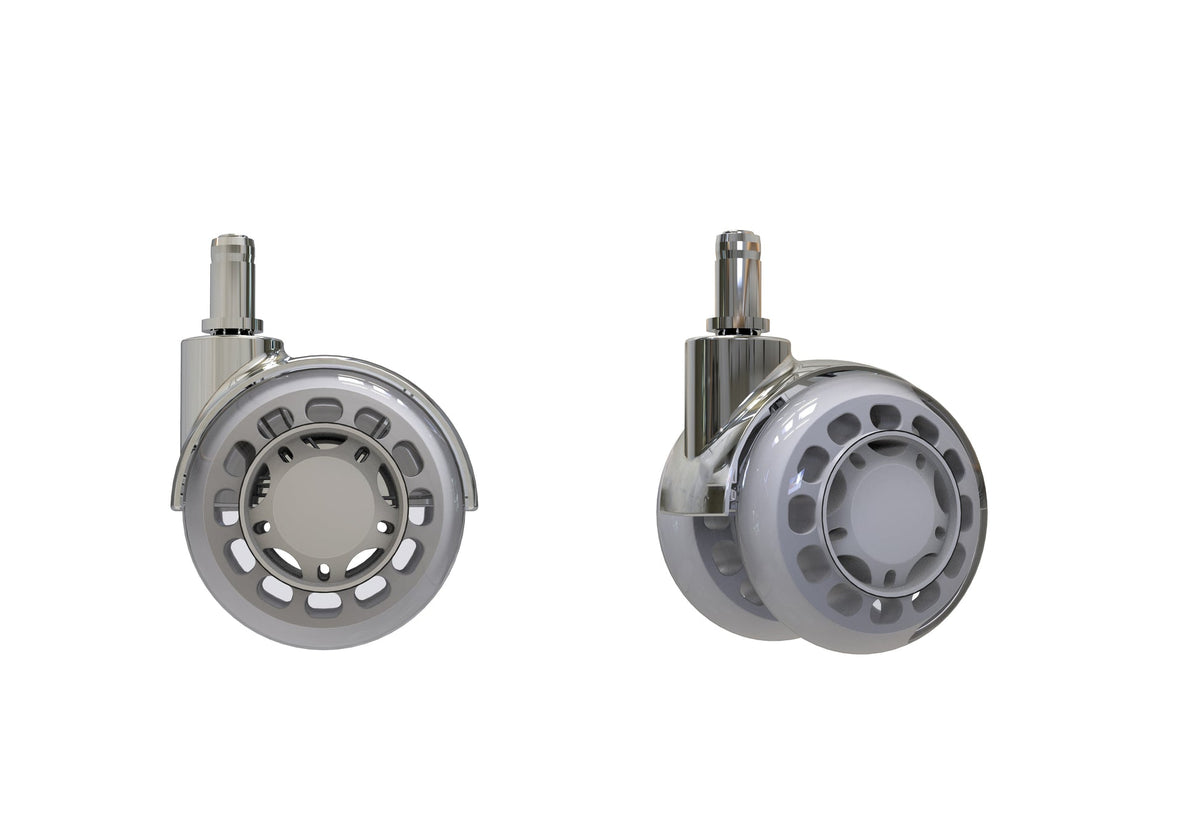
A grip-ring caster has a smooth metal stem with a small retaining ring near the end. The ring compresses as the stem enters its socket and helps retain it after insertion. The smooth shaft diameter and usable stem length are the primary dimensions; the outside of the wheel housing is not a substitute measurement.
Threaded stem
A threaded caster looks like a bolt where it enters the chair or furniture. Diameter and length are not enough: the thread pitch must also match. Do not test a suspected thread by forcing it into the chair. A hardware store or parts supplier can identify the thread with a gauge when the manufacturer does not publish it.
Other mounts are separate families
Grip-neck stems, plate mounts, fixed glides, and proprietary adapters should not be treated as variations of a standard press-fit wheel. If the old caster separates and leaves a sleeve or part of the stem in the base, stop. Photograph the chair label, socket, and complete original assembly, then ask the chair maker or a caster specialist to identify it.
Service Caster’s stem-measurement guide illustrates grip-ring, grip-neck, and threaded stems and recommends calipers or a micrometer for the most accurate diameter measurement. It also explains why threaded stems require the thread specification—not a diameter guess.
Build the Fit Record From the Original Chair
Gather the chair model information, a digital caliper, a ruler, a straightedge, a camera, and the current chair instructions. Record inches and millimeters rather than converting from memory. If a caster is not documented as user-removable or does not release through the approved method, do not pry, heat, drill, or modify it just to obtain a measurement.
- Identify the chair. Record the brand, exact model, serial or production label when available, number of casters, and any listed replacement part. The useful result is a model record that support can recognize. If the label is missing, photograph the entire chair, base, socket area, and caster.
- Confirm the attachment type. Use the manual or a safely removed original caster. The useful result is a specific term such as “grip-ring stem” or a complete thread designation—not “metal pin.” If the mount is unclear, stop the comparison and request identification.
- Measure stem diameter. Close the caliper gently around the smooth shaft, away from a retaining ring, flare, groove, or threads. Record the displayed value and unit. Repeat at a second point to catch a tapered, damaged, or misread surface.
- Measure usable stem length. Measure from the shoulder where the stem leaves the caster assembly to the tip. Do not add the wheel housing, decorative neck, or a sleeve that belongs in the chair base.
- Capture thread details when applicable. Record outside diameter, threaded length, and thread pitch. If you do not have the correct gauge, take the detached caster to a qualified parts counter instead of choosing the nearest-looking thread.
- Record installed geometry. With the original caster upright on a flat surface, measure from the floor-contact point to the shoulder that meets the chair base. Also record wheel diameter and the maximum swivel radius from the stem centerline to the outermost housing edge. These values reveal height and collision changes that stem size alone misses.
- Record the operating conditions. Note the floor material, chair mat if used, thresholds or deep carpet, chair’s published capacity, and whether the original set includes brakes or another behavior that must be preserved.
The completed record should look specific: “grip-ring stem; measured 0.437 in (11.1 mm) diameter and 0.875 in (22.2 mm) usable length; original mounted height recorded; five matching casters; hard-surface workstation.” Those numbers are only a measurement example, not a universal specification. The candidate listing still has to disclose matching tolerances, geometry, set rating, floor use, and chair scope.
Compare the Candidate in a Fixed Order
Do not let a familiar stem size end the review. Compare the replacement to the fit record in this order:
- Exact model approval: Does the chair maker or part listing name your model and variant?
- Attachment: Are the mount and retention method the same?
- Stem: Do diameter, usable length, and any thread specification match within the supplier’s stated tolerance?
- Geometry: Will mounted height and swivel radius preserve base and floor clearance?
- Complete load: Does the supplier document a suitable rating and how that rating applies to a set?
- Floor and behavior: Is the caster intended for the actual floor, mat, rolling resistance, and any brake requirement?
- Set consistency: Are all casters the same design and height, unless the chair maker explicitly authorizes another configuration?
When a listing supplies only “universal,” wheel diameter, and a marketing claim, the match is incomplete. Ask for the missing fields or select a documented model-specific part.
Floor Fit and Chair Fit Are Two Different Decisions
A caster that attaches correctly can still be unsuitable for the workstation. The OSHA computer-workstation chair guidance recommends a strong five-legged base and casters appropriate for the workstation flooring. That means the floor decision belongs inside compatibility—not after installation.
Check the floor manufacturer’s guidance before relying on broad terms such as “non-marking” or “safe for every floor.” On finished wood, grit, a damaged tread, and an unsuitable mat can matter as much as the nominal wheel material. OdinLake’s hardwood-floor protection guide covers that separate floor-care task.
Wheel diameter also does not equal installed height. A larger wheel may raise the chair, but the fork and housing geometry determine the actual change. Compare the floor-to-shoulder measurement for both casters. Then verify that the chair can still reach the desk, support the user’s feet, clear the base through a full swivel, and pass through any tight workspace route.
Use Exact OdinLake Model Scope When It Exists

Checked August 27, 2026, OdinLake’s current Silent Chair Casters replacement listing names the O1, O2, and O3 models. Treat that as a closed model scope. The page does not authorize the same caster for L1, L2, L3, an older revision, or another brand.
For another OdinLake chair, collect the model label and photographs described above, then ask OdinLake support to confirm the current part. If support cannot verify the model, do not convert a visual resemblance into a compatibility claim.
Reject a “Close Enough” Match
Do not install the candidate when any of these conditions remains:
- the attachment type or retention method differs;
- stem diameter, length, thread pitch, or tolerance is unknown;
- the socket is cracked, enlarged, distorted, or holds an old sleeve or broken stem;
- the caster begins to enter but requires unusual force, twisting, grinding, or improvised spacers;
- the new wheel changes installed height or swivel clearance beyond what the chair can accommodate;
- load documentation, floor use, or brake behavior is missing;
- the chair would use a mixed-height or mixed-design set without manufacturer approval.
Do not sand a stem, drill a socket, wrap a loose stem, substitute a random sleeve, or add unapproved washers to make the wheel stay in place. A damaged caster socket or chair base is a support or replacement decision, not a fitting experiment.
Keep Removal and Installation With the Correct Owner
Once compatibility is documented, follow the current chair instructions for removal, installation, and testing. OdinLake’s office-chair wheel replacement guide owns the general replacement journey; use the exact model manual or support direction whenever it differs.
The compatibility task is complete when every required field has a verified match—not when a wheel merely looks similar or partly enters the base. If one field is missing, pause the order and get the specification.
Frequently Asked Questions
Are office chair caster stems a standard size?
No single stem size fits every office chair. A widely sold grip-ring size appears in many replacement listings, but chairs can use other diameters, lengths, threads, sleeves, or proprietary mounts. Measure the original and confirm the exact model rather than treating “standard” as proof.
How do I know which caster wheels fit my office chair?
Start with the chair’s model-specific parts list. Otherwise, identify the attachment type and record stem diameter, usable length, thread pitch when applicable, installed height, swivel clearance, set rating, and floor use. A candidate fits only when all required fields—not just the stem—match.
Are rollerblade-style office chair wheels universal?
No. “Rollerblade-style” describes the wheel form, not the chair connection. The stem, retention method, installed height, base clearance, load documentation, floor guidance, and chair approval still have to match.
Can I replace just one office chair wheel?
Only if the chair maker permits it and the replacement is identical in mount, geometry, height, load behavior, and floor contact. When those fields cannot be matched, use the approved complete set. One different caster can leave the chair uneven or change how it steers.
Will larger caster wheels raise an office chair?
They can, but wheel diameter alone does not predict the change. Compare the complete installed height—from the floor contact point to the shoulder that meets the chair base—and check seat-to-desk fit and base clearance before ordering.
Which office chair casters should I use on hardwood or carpet?
Use the caster type approved by both the chair or caster maker and the floor manufacturer for that surface. Keep the floor and tread clean, and confirm rolling behavior on the actual workstation surface. A broad “all floors” label does not override model or flooring instructions.