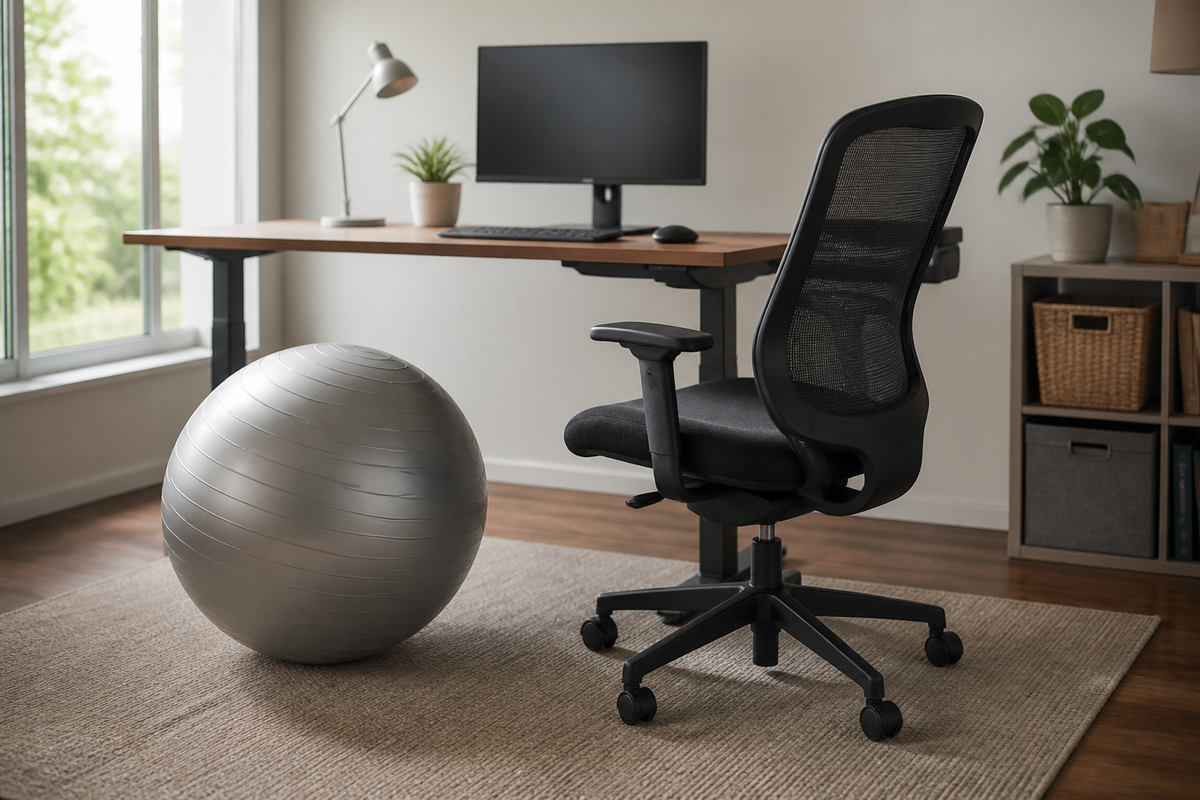
An exercise ball may work as occasional alternate seating, but current evidence does not support treating it as a full-time upgrade over an adjustable office chair.
The right ergonomic setup should adapt to your body, support frequent movement, and stay comfortable through a full workday.
For most computer work, an exercise ball is better treated as optional alternate seating than as a full-time replacement for an adjustable office chair. Research has found small or mixed changes in trunk activity, movement, and energy use, but it has not established a reliable advantage for posture, comfort, back pain, or all-day work. Some studies also report more discomfort, higher physical loading, or practical safety trade-offs.
“Exercise ball,” “stability ball,” “fitness ball,” and “yoga ball” usually describe the same basic inflatable object in this context. A ball mounted in a wheeled frame is a different product, but adding a frame does not automatically give it the adjustability, back support, arm support, or task fit of a conventional office chair. The useful decision is not whether the ball feels active. It is whether the seat lets you perform your actual work safely and comfortably for the period you intend to use it.
The Evidence Does Not Support an Automatic Chair Swap
Studies have measured different outcomes over very different time periods. A short change in muscle activity is not the same as stronger muscles, less pain, or better long-term health. The table below keeps those outcome levels separate.
| Study and exposure | What researchers measured | Result that matters for the decision | Important limit |
|---|---|---|---|
| Gregory and colleagues, 2006: 14 adults completed computer tasks for one hour on each seat | Trunk muscle activity, pelvic position, and perceived discomfort | The ball produced small biological changes and more reported discomfort; the authors did not find it advantageous for prolonged sitting. | Small laboratory sample and one-hour exposure |
| McGill and colleagues, 2006: eight men sat for 30 minutes, with a separate pressure-distribution sample | Muscle activation, spine stability and compression models, posture, and seat contact | Muscle activation and modeled spine measures did not show a clear ball advantage; the larger contact area could create uncomfortable soft-tissue compression. | Small sample, short exposure, and a stable wooden stool rather than a modern adjustable chair as the comparison seat |
| Kingma and van Dieën, 2009: 10 women performed a one-hour typing task | Trunk motion, muscle-activity variation, lumbar muscle activity, and spinal shrinkage | The ball increased motion and variation, but it also increased lumbar muscle activity and spinal shrinkage. The authors concluded that the advantages might not outweigh the disadvantages. | Small laboratory sample and one task |
| Veterans Health Administration workplace evaluation, 2013: monthly rotations among a ball, ball chair, and regular office chair | Self-reported posture, energy, balance, performance, safety, and pain | Some users reported better perceived posture or energy, yet pain was also reported by 42% of ball users and 45% of ball-chair users. The study calls for weighing perceived benefits against risks. | Workplace field evaluation with subjective outcomes, not a blinded clinical trial |
| Randomized crossover study, 2016: up to 90 minutes per day for eight weeks | Low-back pain, disability, and several core-endurance tests | Ball sitting improved some sagittal-plane endurance measures but did not significantly improve pain or disability and did not prevent an increase in low-back pain. | Partial-day use in a mixed university population; the result does not establish an all-day seating benefit |
| Pilot study, 2025: 16 adults sat on four seat types for 10 minutes each | Oxygen consumption, muscle activity, and subjective sensations | The ball produced small short-term physiological changes compared with an office chair with a backrest. | Ten-minute conditions cannot establish weight loss, disease prevention, comfort over a workday, or any long-term outcome |
Taken together, the evidence does not show that a ball is a universally better desk chair. It does show why a simple “active equals healthier” claim is too broad: activity, comfort, task performance, symptoms, and long-term health are different outcomes.
More Muscle Activity Is Not Automatically Better
An unstable seat requires continuous balance corrections. That can change which muscles are active and how much the trunk moves, but muscle activity during sitting is not automatically a useful training dose. Higher sustained activation can also mean earlier fatigue, especially when the task requires concentration, reaching, or precise hand control.
The 2016 crossover study is a useful example of the distinction. Some core-endurance measures improved after scheduled partial-day ball use, but pain and disability did not. That result supports a narrow statement about certain endurance tests, not a promise that ordinary ball sitting strengthens every core muscle, fixes posture, or treats back pain.
Short metabolic studies need the same caution. A measurable change in oxygen use or muscle activity during a brief condition does not establish meaningful weight loss or disease prevention. If core training is the goal, an exercise program gives you control over exercise selection, effort, rest, progression, and technique in a way that typing on an unstable seat does not.
The Workstation Changes When the Seat Can Roll Away
A chair is part of a system that includes the desk, keyboard, mouse, display, floor, and the tasks performed around them. The Canadian Centre for Occupational Health and Safety guidance on alternative seating notes that a fitness ball may encourage dynamic posture, but it can also demand more concentration and coordination, accelerate fatigue, make reaching and moving tasks harder, and increase fall risk compared with other chairs.
Support and adjustability are reduced
A plain exercise ball has no backrest, armrests, seat-depth control, recline resistance, or height lever. Ball height changes with diameter, inflation, user load, and surface compression, so “buy the size for your height” is not a complete workstation-fit method. A ball chair with a frame may add a base or back structure, but its actual adjustment range still has to be checked as a product-specific fact.
By contrast, the OSHA computer-workstation chair guidance emphasizes a supportive backrest, a seat that lets the feet rest on the floor or a footrest, usable arm support when provided, and a stable five-leg base. These are not guarantees of comfort, but they provide controllable variables for fitting the seat to the workstation and changing position.
Movement becomes a demand, not simply an option
Movement can be useful, but the seat should not make every task a balance task. Think about what happens beyond typing: reaching for a drawer, turning to a second surface, handling a drink, joining a video call, reading while reclined, or moving between devices. If the seat makes those ordinary actions less stable or forces you to brace against the desk, it is not completing the job of a primary task chair.
Use Three Decision States Instead of a Yes-or-No Rule
The evidence is clearer when the decision is tied to a role. A ball does not have to be either a miracle chair or completely useless.
| Role | When it may fit | What would rule it out |
|---|---|---|
| Primary chair for prolonged computer work | Rarely the strongest choice because the role demands repeatable support, adjustability, stability, and task access | The ball replaces needed back or arm support, creates a desk-height mismatch, increases fatigue, or makes normal reaching and movement less safe |
| Optional alternate for a limited task | The user can balance safely, the workstation fits without distortion, the task is stationary, and the regular chair remains available | Discomfort, instability, distraction, pressure, numbness, excessive effort, or loss of task control appears |
| Exercise equipment away from the desk | The ball is used for an appropriate exercise program with space, technique, and progression suited to the user | The user assumes passive desk sitting provides the same training effect as purposeful exercise |
| Avoid or obtain individual guidance | A health or workplace professional has evaluated the person, task, duration, and accommodations | There is a balance limitation, recent injury, concerning symptom, unstable floor, damaged ball, unsafe workplace layout, or unresolved accommodation need |
This framework also respects preference without turning preference into proof. Someone may enjoy brief ball sitting and still need a supportive primary chair. Someone else may find the instability tiring immediately. Both observations are useful for that person, but neither establishes a universal health outcome.
A Limited Trial Is a Fit Check, Not a Treatment
If you want to test a ball as occasional alternate seating, make the experiment reversible. Keep the regular chair at the workstation and use the ball only for a low-risk, stationary task. Check the ball manufacturer’s size, load, inflation, care, and surface instructions; inspect the ball for damage; clear the surrounding floor; and confirm that your workplace permits its use.
At the desk, look for observable fit rather than a universal body-height chart:
- Both feet stay flat and stable without wedging them against furniture.
- The ball does not slide, rock unpredictably, or contact a sharp edge.
- The keyboard and mouse remain reachable without lifting the shoulders, leaning onto the desk, or holding the arms away from the body.
- The display remains readable without repeatedly bending the neck or trunk.
- Sitting pressure, balance demand, and attention remain acceptable for the task.
Stop the trial if you feel unstable, increasingly fatigued, distracted by balance, or develop pain, numbness, dizziness, or another concerning symptom. Do not use the ball while reaching to the floor or a high shelf, moving equipment, handling loads, or doing a task that depends on a backrest or arm support. There is no evidence-based universal duration that is safe and useful for everyone. CCOHS specifically notes that when a health professional recommends a ball, the program should define duration, frequency, and other accommodations.
This is intentionally a decision-level check, not a complete ball-seating program. An individual program should come from the ball manufacturer’s instructions and, when health or accommodation needs are involved, an appropriate professional who can evaluate the person and workplace.
Judge the Primary Chair by What It Lets You Control

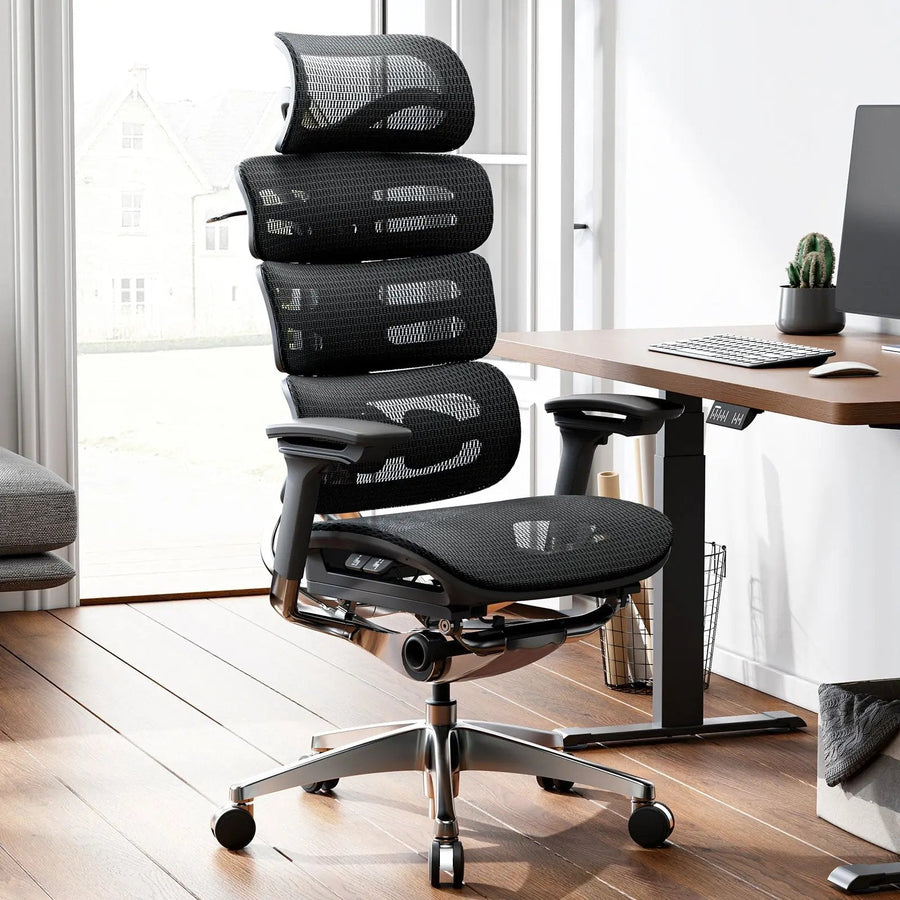
A primary task chair should give you enough range to fit the desk and enough support to vary your seated position. Useful fields include seat-height range, seat depth, backrest and lumbar adjustment, armrest clearance, recline behavior, base stability, caster suitability for the floor, and the manufacturer’s stated user and load limits.
Those fields matter because they let you respond to a mismatch. If the desk is fixed, seat height and a footrest can help align the user with the work surface. If the seat edge presses behind the knees, seat depth or a different chair size may be needed. If the backrest contact is in the wrong place, a model with suitable backrest or lumbar range gives you another variable to change. You can read more about what lumbar support is designed to do without treating it as a medical device.
When you are ready to compare actual chair ranges and features, start with OdinLake’s adjustable office chair collection and verify the current specifications for the exact model and variant. The comparison should still end with a fit and task check, not a feature count.
The Practical Verdict
An exercise ball can be useful exercise equipment and may work as brief alternate seating for some people in a safe, well-fitted setup. Current evidence does not justify treating it as an automatic upgrade over an adjustable office chair for prolonged computer work. The more defensible default is to keep a stable, supportive, adjustable chair as the primary seat and use movement, position changes, or a separately designed exercise session for goals the chair cannot deliver.
If a ball feels better during a short trial, treat that as personal feedback worth investigating—not proof of posture correction or treatment. If symptoms are persistent, sudden, severe, worsening, or accompanied by weakness, numbness, balance changes, or other concerning signs, seek an appropriate health professional rather than trying to solve the problem through a chair swap.
Frequently Asked Questions
Is it okay to sit on an exercise ball all day at work?
Research does not establish an all-day advantage, and a ball lacks many of the support and adjustment controls used to fit a primary task chair. CCOHS also identifies fatigue, task difficulty, and fall risk as possible disadvantages. Keep a supportive chair available and do not assume that tolerating a ball briefly makes it suitable for a full workday.
Does sitting on an exercise ball improve posture?
Not reliably. Laboratory studies have found changes in motion or muscle activity, but they have not shown a consistent posture advantage over conventional seating. A person can also become fatigued or adopt an unwanted position on an exercise ball.
Does an exercise ball chair strengthen your core?
The evidence is mixed and depends on what “strengthen” means. One eight-week study found improvements in some core-endurance tests, while short laboratory studies found small, inconsistent, or no meaningful trunk-activation advantages. Passive desk sitting should not be treated as a substitute for a structured strength or rehabilitation program.
Can an exercise ball chair help back pain?
It should not be presented as a back-pain treatment. In the 2016 randomized crossover study, ball sitting did not significantly improve low-back pain or disability, and other studies have reported discomfort during ball use. Persistent or concerning pain needs an individualized assessment rather than a seating promise.
Is an exercise ball safer than an office chair?
Not as a general rule. A ball is unstable by design, and CCOHS states that it can increase fall risk compared with other chairs and make reaching, swiveling, or moving tasks more difficult. A stable base and task-appropriate support are especially important when the work involves movement beyond the keyboard.
How long should you sit on an exercise ball at a desk?
There is no universal evidence-based duration for every user and workplace. If a low-risk trial is appropriate, keep it brief enough to monitor balance, fatigue, comfort, and task control, and return to the regular chair when any of those deteriorate. A health-professional or workplace-accommodation recommendation should specify duration and frequency for the individual case.
What size exercise ball works with a desk?
Use the ball manufacturer’s current size, load, and inflation guidance, then verify the complete workstation fit. Both feet should remain stable, the work surface should be reachable without shoulder elevation or leaning, and the ball should not need unsafe overinflation or underinflation to reach the desk. A height-only chart cannot account for desk height, footwear, inflation, body proportions, or floor conditions.