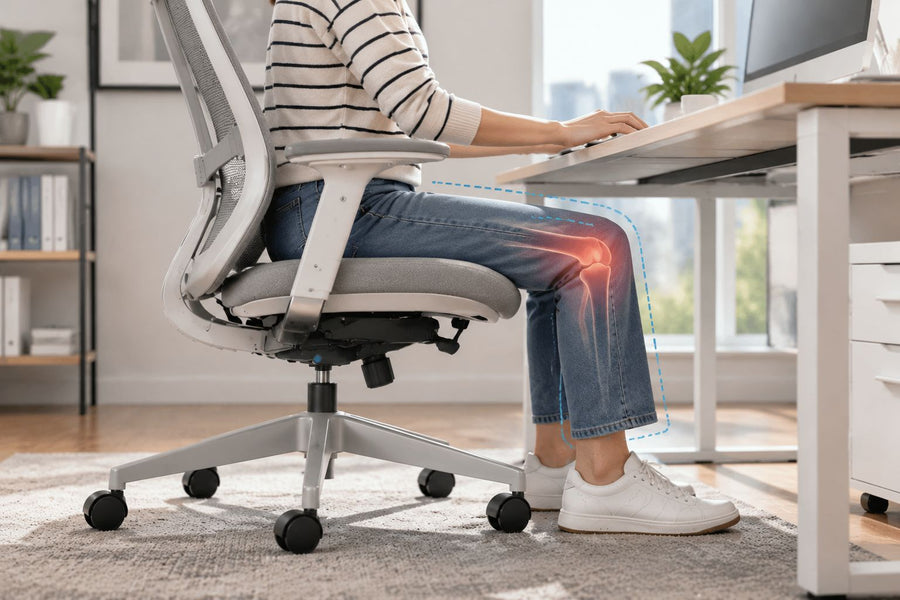
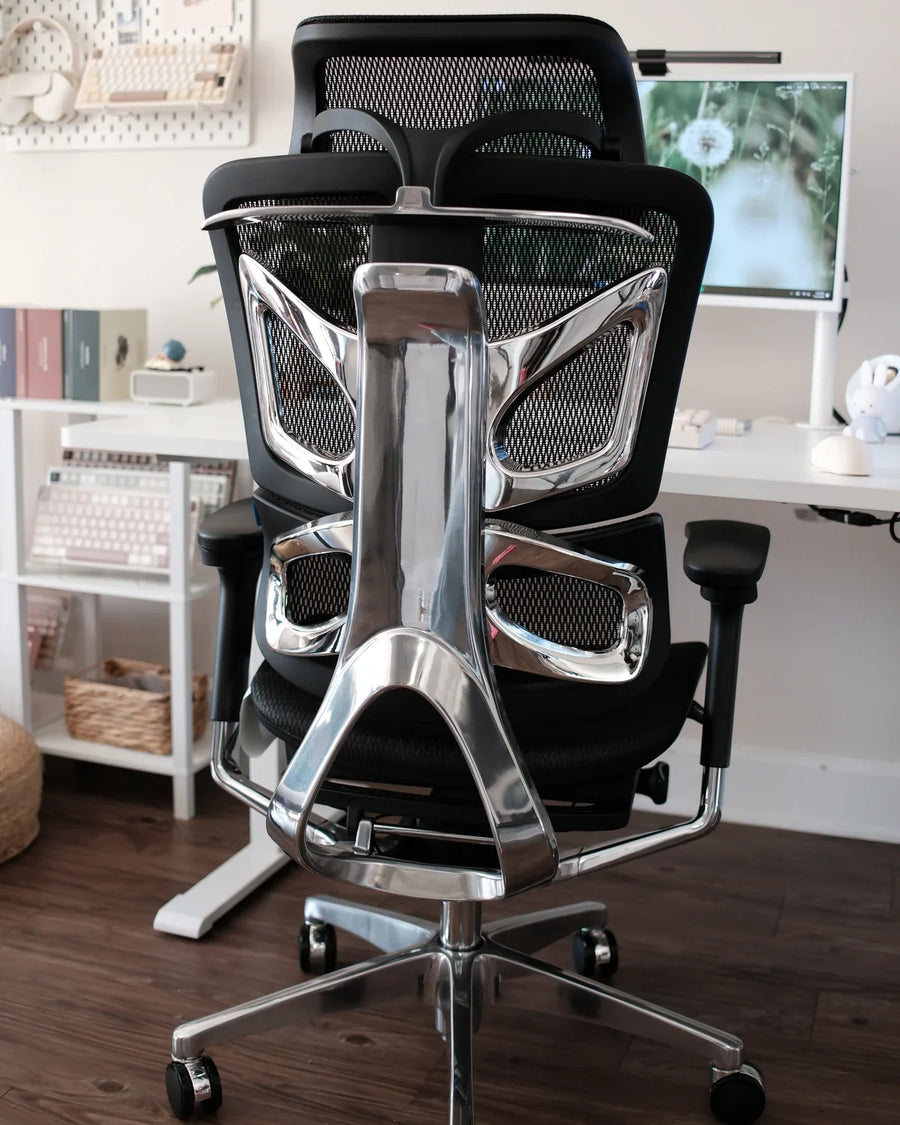
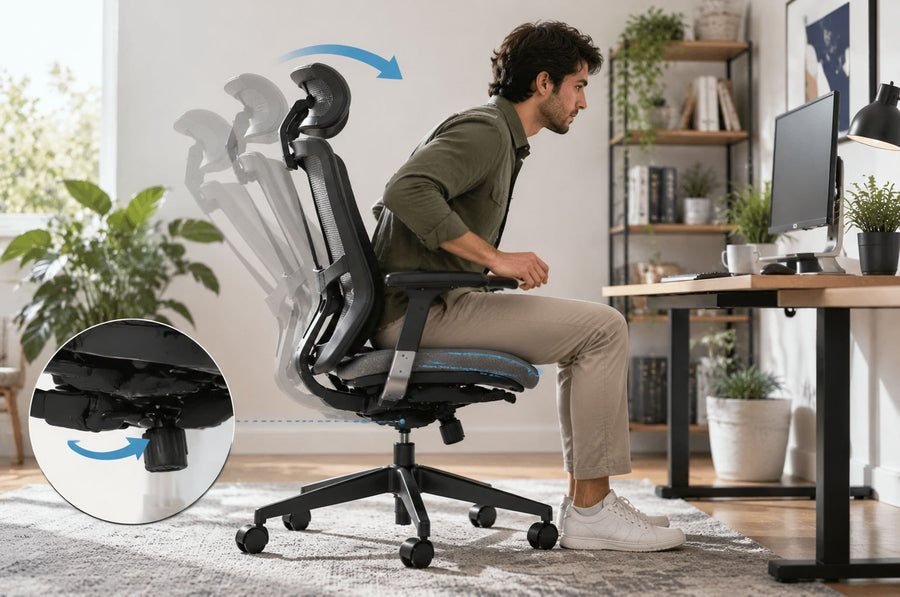
The right ergonomic setup should adapt to your body, support frequent movement, and stay comfortable through a full workday.
If an office chair will not go up, first make sure the seat is unloaded and that you are using the height-control lever described in the chair’s manual. A pneumatic chair normally rises only when the valve is opened with little or no weight on the seat. If the seat still does not rise, the fault may be in the lever or cable, the actuator under the seat, the gas-lift cylinder, or the way a newly assembled chair was put together.
Do not bounce on the seat, pull it upward while someone operates the lever, or open the cylinder. The useful goal is not to force movement; it is to identify the failed zone without turning a repairable height-control problem into a damaged mechanism or pressure-component hazard.
Stop Before Troubleshooting an Unstable Chair
A chair that simply stays at one height is different from a chair that is structurally unstable. Keep the chair out of use and contact the manufacturer or a qualified service provider if you find any of these conditions:
- a sudden wobble, sideways lean, tip, or separation between the seat, cylinder, and base;
- a cracked or bent five-star base, control housing, seat frame, or load-bearing connection;
- a dented, deeply corroded, bulging, punctured, heat-damaged, or modified cylinder;
- an abrupt drop, forceful pop, persistent hissing, metal-on-metal sound, or uncontrolled movement; or
- a missing fastener, damaged cable, exposed sharp edge, or part that does not match the assembly guide.
The UK Health and Safety Executive’s workplace seating guidance says that gas-pedestal chairs contain compressed gas and that a chair which suddenly wobbles or tips should not be examined or repaired by the user. It directs the user to the supplier or manufacturer for expert attention. That boundary matters even when the original complaint was only “the chair will not rise.”
Confirm What “Won’t Go Up” Means
Describe the behavior before naming a failed part. “Won’t go up” can mean the seat is already at its highest position, the wrong lever is being used, the lever is not opening the cylinder valve, the lift no longer has enough extension force, or the seat rises but immediately sinks again. Those outcomes need different next steps.
| What you observe | What it tells you | Next safe action |
|---|---|---|
| The seat rises when nobody is sitting on it | The basic release-and-extension function works | Adjust while unloading the seat; do not pull the lever and remain fully seated |
| The seat does not move and the lever feels blocked | The control may be locked, obstructed, misidentified, or assembled incorrectly | Stop forcing the lever and check the exact control instructions |
| The lever moves loosely with no change at the seat | The linkage, cable, paddle, or actuator may not be engaging | Document the lever movement and ask support for a model-specific check |
| The seat rises only partway or stops lower than before | The cylinder may have lost force, or the installed part may have a different range | Compare the current range with the model specification and service history |
| The seat rises, then lowers after the lever is released | This is a holding problem, not a pure no-rise problem | Use the separate sinking-chair diagnosis |
| The whole chair leans, rocks, or shifts at the center column | A base, socket, mechanism, or structural connection may be involved | Remove the chair from use; do not continue cycling the height control |
Also separate seat-height movement from backrest movement. A recline lever, tilt lock, seat-depth control, or armrest paddle may look similar to the height control. Find the control map for the exact model instead of testing every lever with force.
Run a No-Tools Height-Control Check
Use this sequence only when the chair is upright, visibly intact, and stable on a clear, level floor. Keep fingers, hair, clothing, and tools away from the mechanism under the seat.
- Identify the chair. Photograph the model label, serial or production information, control layout, and complete chair. Retrieve the current manual or assembly guide for that exact model and revision.
- Record the starting state. Measure the seat height from one defined floor point to one defined seat point. Note whether the chair is at its apparent minimum, maximum, or an unknown position.
- Clear the seat. Remove the user, bag, cushion, and any other load that is not part of the chair. Make sure nothing above the chair will be struck if the seat rises.
- Operate the correct lever once. Stand beside the chair, keep your face away from the underside, and use the height control exactly as the manual shows. The expected observation for a conventional pneumatic lift is a controlled rise of the unloaded seat.
- Release and observe. The control should return as designed, and the seat should remain at the new height. If the lever sticks, the seat moves abruptly, or the chair becomes unstable, stop.
- Record the result. A short video showing the chair, control action, and seat response is more useful to support than repeated attempts or a guess that “the hydraulics are broken.”
This check does not prove which internal part failed. It only separates correct unloaded operation from a no-response, partial-response, or hold-height problem. Do not crawl under an occupied chair or press the cylinder actuator directly.
Trace the Fault Through Three Zones
Zone 1: The control the user touches
Confirm the height-control direction and whether the model uses a lever, paddle, cable, or integrated armrest control. Some controls pull upward; others move in a model-specific direction. A lever that will not travel may be locked, obstructed, bent, or connected to a different function. Do not force it past its normal stop.
A lever that moves unusually freely may not be transferring motion to the actuator. That can happen after incorrect assembly, transport, or a disconnected cable, but the appropriate inspection depends on the chair. Do not remove the seat or control cover unless the current manual or support instructions explicitly make that a user step.
Zone 2: The actuator and seat mechanism
The user control must reach the activation point on the gas lift. If the seat mechanism is installed in the wrong orientation, a cable is routed incorrectly, or the wrong hardware is present, the lever may move without opening the valve. A control adjusted too far can also keep the valve open and create the opposite symptom: a seat that will not hold height.
For a new or recently reassembled chair, compare the complete underside with the illustrated parts list and assembly sequence. Check only visible orientation, cable routing, covers, and fasteners that the guide identifies. If a required piece is missing or the mechanism differs from the drawing, stop and send photographs to support rather than improvising a set-screw adjustment from another chair.
Zone 3: The sealed gas-lift cylinder
If the correct control visibly engages but the unloaded seat does not rise, the cylinder may have lost extension force or may be stuck. That conclusion still needs model-specific confirmation: the actuator, socket geometry, and replacement history can produce similar symptoms.
Gas-spring manufacturer SUSPA explains in its technical FAQ that a gas spring stores pressure, that a lockable design uses a valve to control movement, and that its sealed gas springs are not repairable by opening them. For a chair owner, that supports a firm boundary: do not drill, cut, heat, refill, lubricate internally, or dismantle the pressure tube. A failed lift is handled through an approved replacement, not an internal repair.
Do Not Diagnose by Internet Hack
Many chair-height videos begin by removing the seat, turning a hidden screw, striking the cylinder, adding a pipe sleeve, or clamping the center column. Those actions may apply to a specific model or a different symptom. They are not a universal first response to a chair that will not rise.
- Do not pull the seat upward while another person operates the lever. A sudden release can pinch fingers or destabilize the chair.
- Do not press the actuator pin by hand or with a tool. The correct control and loading state should operate it.
- Do not adjust an unidentified screw. It may control tilt tension, linkage position, or another mechanism.
- Do not spray WD-40, silicone, oil, or cleaner into the cylinder or seat mechanism. Use only a product and location approved in the exact care instructions.
- Do not drill, heat, cut, clamp, weld, or refill the gas lift. It is a sealed pressure component.
- Do not order a part because it looks standard. Physical insertion does not prove the activation, length, stroke, capacity, or chair-height range is correct.
If the cylinder itself is dented, altered, or behaving violently, use the stricter boundaries in the office-chair gas-lift safety guide and keep the chair out of service.
Choose Repair, Warranty Service, or Replacement
A replacement cylinder is reasonable only when the chair’s base, seat mechanism, frame, casters, and upholstery remain serviceable, the no-rise symptom has been traced to the lift, and a compatible part plus approved installation route is available. If several load-bearing parts are damaged, the model cannot be identified, or no supported part exists, replacing the complete chair may be the safer and more economical decision.
| Decision state | Evidence needed | Action |
|---|---|---|
| Control-use issue | The unloaded chair rises when the documented control is used correctly | Keep the manual accessible and reset the chair to a verified working height |
| Assembly or linkage issue | The parts, orientation, cable, or control behavior differs from the current guide | Use warranty or support instructions before removing covers or the seat |
| Likely cylinder fault | The correct control engages, the structure is sound, and support confirms the lift | Use the exact approved replacement and service procedure |
| Structural or pressure-component concern | Crack, bend, looseness, sudden wobble, tip, drop, or cylinder damage | Stop use and obtain qualified assessment; do not continue home testing |
| Unknown chair or incompatible part path | Model, revision, interface, rating, or procedure cannot be verified | Keep the chair unloaded until the manufacturer identifies a safe route |
Check the warranty before disassembly. OdinLake’s current warranty policy separates coverage by model and component, so the exact chair, purchase channel, proof of purchase, and affected part matter. Save the policy version that applies to the order and ask support before a repair that may change eligibility.
Use Exact Model Scope for an OdinLake Chair
Start with OdinLake’s assembly videos and product guides to identify the chair and its control layout. If the guide does not cover the symptom, use the Help Center or contact support with the model label, order information, starting seat height, lever behavior, photographs, and a short no-load video.
OdinLake’s current 4.7-inch replacement gas-lift page names O1, O2, and O3 chairs and publishes that part’s dimensions and rating. That is a model boundary, not permission to use the part in every OdinLake chair or every production revision. Have support confirm the current part before removal or ordering.
Once the chair rises, lowers, and holds height normally, reset the seat for the actual user and workstation. The repair is not complete merely because the seat moves; the chair must remain level, stable, fully assembled, and within its documented operating range.
Frequently Asked Questions
Why won’t my office chair go up when I pull the lever?
The seat may still be loaded, the wrong control may be in use, the lever or cable may not reach the actuator, or the gas lift may have lost extension force. Test once with the chair unloaded and the exact manual in hand. If the control does not behave as documented, stop forcing it and record the result for support.
Do I need to get off the chair to raise it?
A conventional pneumatic office chair normally rises when the height valve is opened with little or no weight on the seat. Stand beside the stable chair and use the documented control. Some chairs use different systems, so the model manual controls.
Does a chair that won’t rise always need a new cylinder?
No. A blocked or misidentified lever, disconnected linkage, cable problem, incorrect assembly, or actuator issue can produce the same symptom. Confirm the control path and model before ordering a cylinder.
Can I refill or regas an office chair cylinder?
Do not open, drill, cut, heat, or attempt to refill a chair gas lift. It is a sealed pressure component, and gas-spring manufacturers warn against unauthorized opening or modification. Replace a confirmed failed lift only with a model-compatible part and approved method.
Why does the chair go up but not stay up?
That is a hold-height fault rather than a no-rise fault. A worn cylinder seal or a control that keeps the valve open may be involved. Keep using conditions controlled and follow the sinking-chair diagnostic instead of adding a clamp or pipe sleeve.
Should I replace the gas lift or the whole office chair?
Replace the lift when the cylinder is the confirmed fault, the rest of the chair is structurally sound, and an approved compatible part and service method exist. Replace or professionally assess the complete chair when there is structural damage, multiple failed systems, an unknown model, or no verifiable part path.