Separate product weight, shipping-carton weight, and lifting capacity so you can plan delivery, moving, equipment load, and floor questions correctly.
The right ergonomic setup should adapt to your body, support frequent movement, and stay comfortable through a full workday.
A standing desk can be light enough to move in parts or heavy enough to require equipment and a planned route, but there is no single “typical” weight you should use for a real decision. Find the exact model’s assembled product weight, the gross weight of each shipping carton, and the load the lift system must move. Those are three different numbers.
Use assembled weight when planning a move or recording the complete workstation. Use each carton’s shipping weight when receiving or carrying boxes. Use lifting capacity only to evaluate the equipment that rises with the desk. Never substitute one figure for another, and do not treat a published capacity as the desk’s own weight.
- Name the decision. Decide whether you are moving the desk, receiving it, checking the floor, or checking the lift system.
- Find the labeled figure. Start with the current product page and manual, then check every carton label.
- Confirm what the number includes. “Product weight,” “shipping weight,” “frame capacity,” and “desk capacity” may cover different objects.
- Record dimensions with weight. A wide, awkward desk can be difficult to control even when its weight sounds manageable.
- Measure only manageable components. Weigh removable equipment or disassembled parts on a suitable scale; do not balance an assembled desk on a bathroom scale.
- Escalate uncertainty. Ask the manufacturer about an unclear specification and ask facilities or a qualified building professional about an unusual floor condition.
First, decide which standing-desk weight you need
The phrase “How heavy is a standing desk?” hides several different tasks. The correct number depends on the decision you are trying to make.
| Decision | Weight to collect | Other information needed | Common mistake |
|---|---|---|---|
| Move an assembled desk | Assembled product weight plus removable equipment | Overall dimensions, route, stairs, doors, handholds, and whether the desk can be disassembled | Using the lift capacity as though it were the desk’s weight |
| Receive or carry the delivery | Gross shipping weight of each carton | Carton dimensions, number of cartons, delivery point, and handling instructions | Assuming one listed shipping weight covers every box |
| Check the lift system | The load that the mechanism actually raises | Whether the published capacity applies to a complete desk or a frame, and whether the desktop is included | Subtracting or adding the desktop without checking the manual’s definition |
| Check a floor or room | Complete station weight: desk, equipment, stored items, and relevant nearby loads | Foot or caster contact, weight distribution, floor condition, structure, and property rules | Treating a simple pounds-per-square-foot calculation as structural approval |
A product listing that says “250 lb capacity” has not told you that the desk weighs 250 lb. It has stated a limit for some defined supported or moving load. Likewise, a carton marked 70 lb does not prove the assembled desk weighs 70 lb: packaging adds weight, and another carton may still be part of the shipment.
Keep a three-number standing-desk weight record
Instead of looking for one universal answer, build a small record for the exact model. This makes the information reusable for delivery, setup, relocation, and equipment changes.
| Record | What it means | Best source | How to write it |
|---|---|---|---|
| Assembled weight | The configured desk itself after assembly, before adding monitors and other equipment | Model-specific product page, specification sheet, or manual | “Product weight: ___; configuration: ___; source and date: ___” |
| Carton weights | The gross weight of each sealed package, including parts and packaging | Every carton label or a model-specific packing list | “Box 1 of 2: ___; Box 2 of 2: ___; dimensions: ___” |
| Moving load | The top, equipment, accessories, cables, and other objects the lift system raises, as defined by the manufacturer | The current product specification and manual, supported by your equipment inventory | “Published capacity: ___; definition: ___; installed moving load: ___” |
Record the configuration because one model name may be sold with several desktop sizes, frame options, or packages. Record the access date because online specifications can change. If a field is not stated, write “not confirmed” rather than filling it with an estimate from a similar desk.
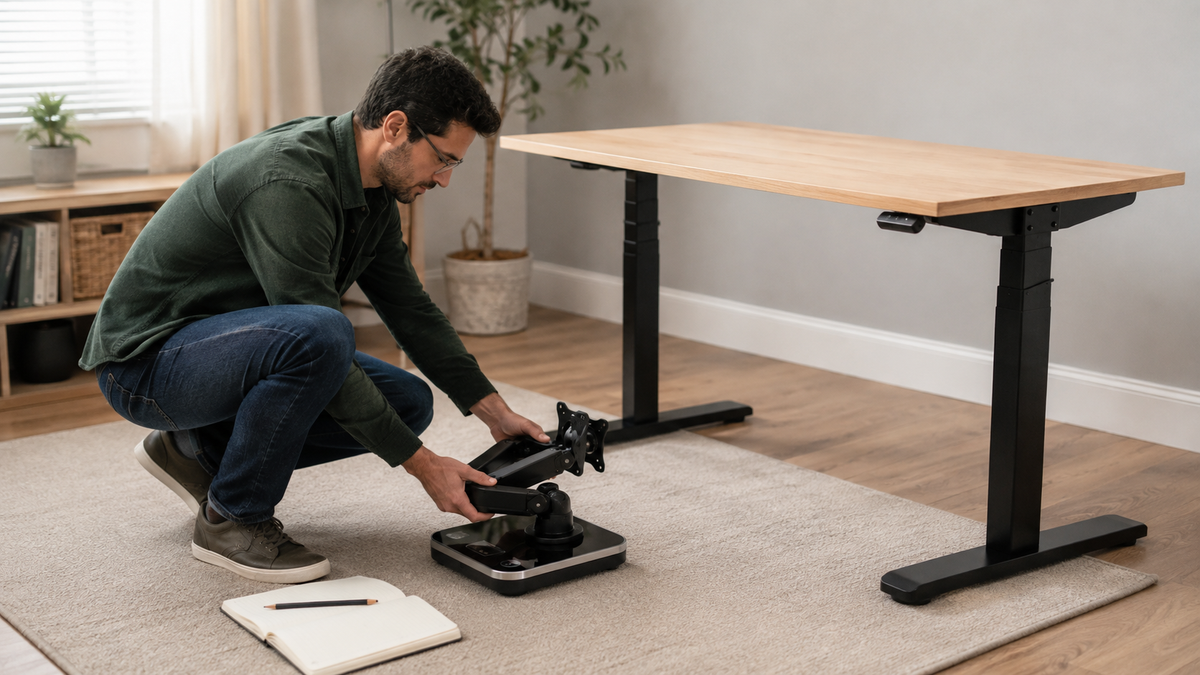
The generated image for this guide shows the safe scope of home measurement: a removable accessory on a suitable platform scale beside a lowered, cleared desk. It is an illustration of the documentation task, not a product, capacity, or lifting recommendation.
Use sources in an order that preserves the label
Start with the manufacturer’s current product page for the exact model and configuration. Then read the specification sheet or manual. Search for labels such as “product weight,” “net weight,” “gross weight,” “shipping weight,” “maximum load,” “weight capacity,” and “lifting capacity.” The label and its scope are as important as the number.
Next, inspect every shipping carton. A multi-box desk may have a desktop in one package and the frame, legs, hardware, or accessories in another. Copy each package’s gross weight separately. If an online page lists a shipping weight under a desktop-size selector, confirm whether that figure covers the desktop package, one carton, or the complete shipment before using it for a receiving plan.
If the product page and manual disagree, or the configuration is unclear, contact the manufacturer with the model, desktop size, order identifier, and the exact field you need. Ask a narrow question: “What is the assembled product weight for this configuration?” or “Is this capacity stated for the complete desk, and does it include the desktop?” Keep the answer with the manual.
Retailer filters, search snippets, forum estimates, and figures for a similar-looking model are discovery aids, not authoritative values for your desk. A usable record connects each number to a model, configuration, label, and source.
Example: separate product weight from capacity
The current OdinLake S3 Home Office L-Shaped Standing Desk product page, checked September 5, 2026, lists a product weight of 84.9 lb and a capacity of 250 lb. These two published numbers answer different questions.
- 84.9 lb is the page’s product-weight figure for that model listing. It is the relevant starting point for the desk’s own weight.
- 250 lb is the page’s capacity figure. It is not the desk’s weight, a shipping weight, or a statement that a person should carry that amount.
This is one current model example, not an industry average. Before using either figure, confirm that the page matches the configuration you own and read the current manual for the capacity definition. For receiving, use the actual gross weight and dimensions on every carton rather than trying to derive shipping weight from the product-weight figure.
How to estimate the weight of your complete workstation
For room planning or an equipment inventory, begin with the confirmed assembled product weight and add everything that remains on or attached to the station: desktop computer, monitors, arms, dock, speakers, lighting, trays, power equipment, mounted drawers, and stored items. Record each value and its source. The result is an inventory estimate, not a structural certification.
For checking the lift system, do not automatically use that same total. Follow the manufacturer’s capacity definition. A complete-desk capacity may be stated differently from a frame-only capacity; the desktop may already be accounted for in one specification and need to be counted in another. If the manual does not define the load boundary, ask the manufacturer rather than inventing a subtraction.
Weigh small, removable items directly when the scale’s range and platform suit the object. If necessary, a stable person-plus-item measurement minus the person-alone measurement can estimate a small item on a bathroom scale. Keep the item close, step on and off normally, and do not use this method for large, sharp, unstable, or awkward components.
Do not tip, hoist, or balance a complete assembled desk onto a household scale. If you need a verified assembled weight and it is not published, contact the manufacturer or use appropriate commercial weighing equipment with trained help. Measurement should not create the handling hazard you were trying to assess.
Weight alone cannot tell you whether one person should move it
There is no defensible universal “solo lift” cutoff for a standing desk. The NIOSH researchers’ paper describing the Revised NIOSH Lifting Equation shows why object weight is not the only input. The method also evaluates task geometry, asymmetry, lifting frequency and duration, and the quality of the hand-to-object coupling.
A standing desk is often wide, hard to grip, top-heavy when assembled, and able to shift at joints or moving parts. Stairs, turns, thresholds, slippery floors, poor lighting, and a long carry make the task different from lifting a compact box of equal weight. A number on a specification sheet cannot account for the route or the people doing the work.
Before moving the desk, lower it according to the manual, unplug it, clear the surface, secure permitted moving parts, and determine whether the manufacturer allows disassembly. Test a manageable component’s stability before committing to a carry. Use appropriate handling equipment and trained help when the object or route cannot be controlled. For the complete route, packing, disassembly, and recommissioning workflow, use OdinLake’s guide to moving a standing desk.
Does a heavy standing desk need a floor check?
A desk’s total weight is useful input, but it does not answer a structural question by itself. The load may be distributed through two feet, four feet, casters, glides, or another base. A heavy desktop, storage cabinet, nearby furniture, occupants, and equipment can concentrate weight in the same area. The floor’s construction, span, condition, and prior damage also matter.
Do not divide the desk’s weight by the desktop footprint and treat the result as permission. The desktop outline is not necessarily the area through which the base transfers load to the floor. A floor protector can reduce scratches or pressure marks on a finish, but it does not increase the structural capacity of the building.
For an ordinary desk on a sound, code-compliant floor, a special calculation may not be part of the normal setup process. Ask the landlord, property manager, facilities team, or a qualified structural professional when the desk has an unusually heavy stone or solid-wood top, equipment or storage adds substantial load, the floor is old or damaged, the base creates concentrated contact points, the room has known restrictions, or you simply cannot confirm the condition. Give them the complete station weight, base dimensions and contact points, proposed location, and any known floor information.
A five-minute weight check before buying or moving
- Write the exact model, desktop size, frame option, and any attached storage or accessories.
- Copy the assembled product weight from the current official page or manual and record the source date.
- Copy the gross weight and dimensions from every package label; note the total carton count.
- Copy the published capacity with its exact label and definition. Mark the desktop as included, excluded, or unconfirmed.
- List every removable item that will travel with the desk or rise with it.
- Measure the route, doors, stairs, elevator, and proposed location; record the base contact points.
- Resolve every “unconfirmed” field with the manufacturer, property manager, or appropriate qualified professional before relying on it.
The useful answer to “How heavy is a standing desk?” is not a broad range. It is a labeled, model-specific record that tells you which weight applies to which decision. Once those boundaries are clear, you can plan delivery, equipment load, relocation, or escalation without turning a capacity figure into a false product weight.
Frequently Asked Questions
How much does an electric standing desk weigh?
There is no single reliable weight for all electric standing desks. Desktop size and material, frame design, motors, legs, crossbars, storage, and configuration all change the result. Use the assembled product weight for the exact model and configuration instead of an industry estimate.
Is shipping weight the same as assembled weight?
No. Shipping weight is normally the gross weight of a package, including packaging, and a desk may arrive in multiple cartons. Assembled product weight describes the configured desk itself. Record each carton separately and do not derive one value from the other.
Does a standing desk’s weight capacity include the desktop?
It depends on how the manufacturer defines the specification. A complete-desk listing and a frame-only listing may use different load boundaries. Check the exact model’s current manual or ask the manufacturer; label the desktop as included, excluded, or unconfirmed in your record.
Can one person move a standing desk?
Weight alone cannot answer that. Desk dimensions, handholds, stability, stairs, turns, distance, frequency, and the person’s ability all affect the task. Follow the manual, remove equipment, consider permitted disassembly, inspect the route, and use trained help or handling equipment when the desk cannot be controlled.
How can I weigh a standing desk at home?
First look for the exact model’s product weight. You can weigh small removable accessories or manageable disassembled components on a suitable scale, staying within its capacity. Do not balance an assembled desk on a bathroom scale; ask the manufacturer or use appropriate commercial equipment if an unpublished verified weight is necessary.
Is a standing desk too heavy for an upstairs floor?
A desk weight alone cannot certify a floor. Record the complete station weight, base contact points, proposed location, nearby loads, and known floor condition. Ask the property manager, facilities team, or a qualified structural professional when the top or equipment is unusually heavy, the floor is old or damaged, or restrictions are unclear.
Before you use any number, add its label. “84.9 lb product weight” and “250 lb capacity” are actionable; “the desk is 250 lb” is not. That one habit prevents the most common standing-desk weight mistake.